
Bitcoin Is Dead… Again? Why the World's Largest Cryptocurrency Refuses to Die
Is Bitcoin really dead? Explore the facts behind crypto winters, institutional adoption, quantum computing risks, Bitcoin ETFs and why the world's largest cryptocurrency keeps surviving.
JayJarwar Insights
7/8/20264 min read

Introduction: The Most Repeated Prediction in Modern Finance
Every major market correction seems to produce the same headline:
"Bitcoin is dead."
Financial commentators declare its collapse. Economists question its value. Critics predict its permanent disappearance. Social media fills with jokes about the end of cryptocurrency.
And yet, every few years, Bitcoin seems to surprise the world once again.
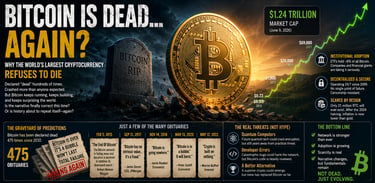
Since its creation in 2009, Bitcoin has reportedly been declared "dead" hundreds of times. Entire websites now track these predictions, documenting more than 475 public Bitcoin obituaries from journalists, investors, economists and business leaders.
Despite repeated crashes, regulatory pressure, exchange failures and periods of intense pessimism, Bitcoin continues operating exactly as it was designed to do.
So, is the narrative finally correct this time?
Or is history simply repeating itself?
Bitcoin Has Survived Every Crypto Winter
Bitcoin's history has never been a straight line.
Instead, it has moved through dramatic cycles of euphoria and fear.
After every major bull market comes a painful correction. Prices sometimes fall by 50%, 70% or even more.
These periods are commonly known as crypto winters.
Each winter produces headlines predicting Bitcoin's demise.
Yet something remarkable has happened every single time.
The Bitcoin network has continued validating transactions.
Blocks have continued being mined.
The blockchain has never stopped operating.
Investors have left.
Developers have stayed.
The protocol has simply continued doing its job.
Why Many People Think Bitcoin Is Dead
Bitcoin's critics raise several legitimate concerns.
Unlike traditional currencies, Bitcoin produces no cash flow.
Its price remains highly volatile.
Governments continue debating regulations.
Criminal misuse occasionally dominates headlines.
Large price corrections can erase hundreds of billions of dollars in market value within weeks.
For new investors, such declines naturally create fear.
When prices fall sharply, the conclusion often appears obvious:
"If the price collapsed, Bitcoin must have failed."
History, however, tells a more complicated story.
The Difference Between Price and Network
One of the biggest misunderstandings surrounding Bitcoin is confusing price with technology.
Bitcoin's market price changes every second.
Its blockchain continues functioning regardless.
Even during the largest market crashes, Bitcoin has continued processing transactions around the clock without interruption.
Banks close.
Stock exchanges have trading hours.
Bitcoin never sleeps.
This distinction explains why many analysts argue that falling prices do not necessarily indicate technological failure.
Institutional Investors Have Changed the Story
Bitcoin today is very different from Bitcoin a decade ago.
In its early years, most buyers were retail investors and technology enthusiasts.
Today, institutional participation has become one of Bitcoin's strongest pillars.
Spot Bitcoin exchange-traded funds (ETFs), publicly listed companies, hedge funds and financial institutions now collectively hold substantial quantities of Bitcoin.
Major asset managers that once ignored cryptocurrencies are increasingly treating Bitcoin as a legitimate alternative asset.
This institutional adoption does not eliminate volatility.
But it does provide a stronger foundation than previous market cycles.
Could Bitcoin Actually Fail?
Although Bitcoin has survived repeated crises, saying it is indestructible would be inaccurate.
Several genuine risks remain.
1. Quantum Computing
Future quantum computers could eventually challenge today's encryption methods.
If quantum technology advances faster than Bitcoin's security upgrades, new risks could emerge.
Fortunately, most experts believe practical quantum attacks remain years away, giving developers time to adapt.
2. Software Failures
Bitcoin relies on open-source software maintained by developers worldwide.
A catastrophic programming error could damage confidence in the network.
Fortunately, Bitcoin's conservative development process makes major protocol changes deliberately slow and heavily reviewed.
3. Better Competition
Another cryptocurrency could theoretically emerge offering superior security, scalability and long-term value storage.
So far, however, thousands of cryptocurrencies have appeared without replacing Bitcoin's dominant position.
Bitcoin continues benefiting from its first-mover advantage, strongest brand recognition and largest decentralized network.
The "Digital Gold" Narrative
One of Bitcoin's strongest investment arguments is its fixed supply.
Unlike traditional currencies, governments cannot simply print more Bitcoin.
Only 21 million bitcoins will ever exist.
Following the 2024 Bitcoin halving, Bitcoin's annual issuance rate fell below the estimated rate at which new gold enters global circulation through mining.
Supporters argue this increasing scarcity strengthens Bitcoin's role as digital gold.
New to Bitcoin? Read our beginner-friendly guide, Why Bitcoin Is More Than Just Another Cryptocurrency, to understand why millions of investors consider it a revolutionary digital asset.
Critics remain unconvinced.
But scarcity continues to form the foundation of Bitcoin's long-term investment thesis.
Why the Obituaries Keep Returning
Why does Bitcoin keep getting declared dead?
The answer may lie in expectations.
Bitcoin is unlike any previous financial asset.
Its volatility is extreme.
Its technology is unfamiliar.
Its success challenges long-established assumptions about money, banking and government-issued currencies.
Every major decline appears to validate critics.
Every major recovery surprises them again.
After sixteen years, the cycle has become almost predictable.
Prices rise.
Optimism returns.
Prices fall.
Bitcoin is declared dead.
Then the cycle begins again.
Conclusion: Dead or Simply Misunderstood?
Bitcoin may eventually fail.
No technology lasts forever.
Future innovations, regulatory changes or unforeseen technological developments could reshape the cryptocurrency landscape.
But today's evidence suggests something very different from the popular narrative.
Bitcoin continues operating.
Its blockchain remains secure.
Institutional adoption continues expanding.
Developers continue improving the ecosystem.
Investors continue debating its future.
Most importantly, the network itself has never stopped functioning.
Perhaps the better question is not "Is Bitcoin dead?"
Want to Build Strong Financial Habits?
Bitcoin is only one part of personal finance. If you want to understand budgeting, investing, saving and building long-term wealth, read our article "Financial Literacy & Skills Development: The Only Sustainable Way to Break the Chains of Poverty and Unemployment."
Instead, history encourages us to ask:
Why has the world's most frequently declared dead financial asset continued surviving for more than sixteen years?
Whether Bitcoin ultimately becomes a permanent global store of value or simply another chapter in financial history remains uncertain.
What seems increasingly certain, however, is that writing its obituary has repeatedly proven far easier than burying it.
JayJarwar Insights
Ideas • Analysis • Perspectives
© 2026 JayJarwar Insights. All Rights Reserved.