
Drone Warfare: How Cheap Drones Are Reshaping Modern War
Cheap FPV drones, AI and mass attacks are changing warfare from Ukraine to the Middle East. See why they matter—and how counter-drone systems are fighting back.
GEOPOLITICSTECHNOLOGY
By Jay Jarwar
7/11/20267 min read
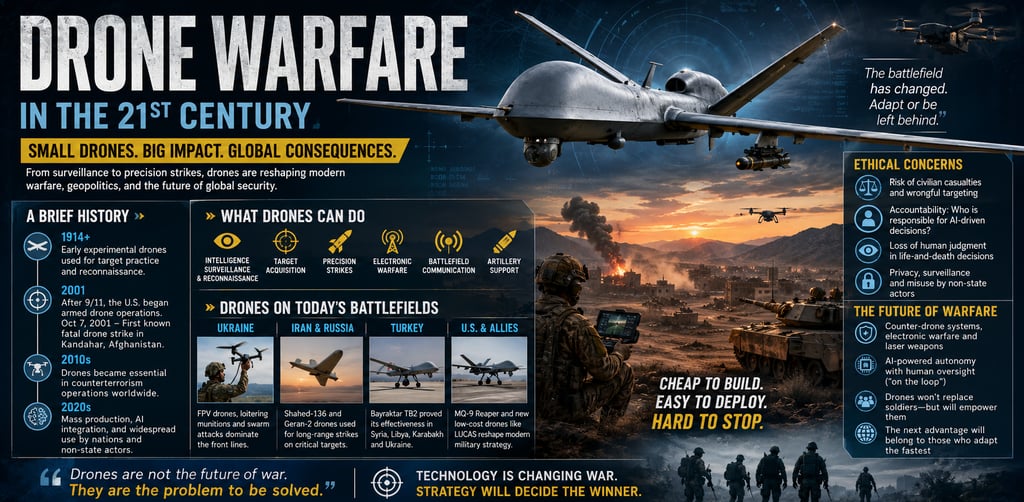

Why Cheap Drones Are Changing the Battlefield
A relatively inexpensive first-person-view drone can now threaten armoured vehicles, artillery positions and other military equipment worth vastly more than the drone itself. From Ukraine to the Middle East, this cost imbalance is forcing militaries to reconsider how expensive platforms can be protected against large numbers of disposable unmanned systems. What was once considered an auxiliary military tool has evolved into one of the most influential technologies of the twenty-first century. Yet behind the remarkable success of drones lies a much bigger question: Are drones the future of warfare, or simply the latest challenge armies must overcome?
From Primitive Aircraft to Precision Weapons
Although drones appear to be a modern invention, their origins date back to the First World War. Early unmanned aircraft were little more than experimental flying machines designed for target practice or basic reconnaissance.
Throughout much of the twentieth century, drones remained on the margins of military strategy. During the Vietnam War they assisted intelligence missions, while many were used simply as aerial targets during weapons testing.
Everything changed after the terrorist attacks of 11 September 2001.
The United States rapidly expanded drone operations in Afghanistan, Pakistan, Yemen and Somalia. Aircraft such as the MQ-1 Predator and later the MQ-9 Reaper demonstrated an entirely new way of fighting wars. These drones could remain airborne for many hours, observe a target continuously and launch precision-guided Hellfire missiles without placing pilots in danger.
After 2001, armed remotely piloted aircraft became an increasingly important part of U.S. counterterrorism operations, demonstrating how long-endurance surveillance could be combined with precision-guided weapons without placing an onboard pilot at risk.
Why Militaries Have Embraced Drones
Modern militaries value drones because they combine intelligence gathering, persistence and precision at comparatively low cost.
Unlike conventional fighter aircraft, drones do not require onboard pilots or expensive life-support systems. Many can stay airborne for more than twenty-four hours while transmitting real-time intelligence to commanders hundreds or even thousands of kilometres away.
Today's UAVs perform an impressive range of missions:
Intelligence, Surveillance and Reconnaissance (ISR)
Precision strikes against high-value targets
Border surveillance
Artillery spotting
Electronic warfare
Search and rescue
Battle damage assessment
Logistics support
Communications relay
NATO’s analysis of the war in Ukraine shows how deeply drones have become integrated into battlefield operations. Reconnaissance, artillery adjustment, targeting and strike missions increasingly depend on unmanned systems operating alongside conventional forces.
The Democratization of Air Power
Perhaps the greatest strategic consequence of drones is that they have democratized military power.
For decades, effective airpower belonged almost exclusively to wealthy nations possessing advanced fighter aircraft and sophisticated air forces.
That advantage has not disappeared, but inexpensive unmanned systems have lowered the cost of gaining some forms of aerial reconnaissance and strike capability.
Commercial quadcopters costing only a few hundred dollars can be modified to carry explosives or conduct reconnaissance. Countries with relatively modest defence budgets now field capable drone fleets.
Iran illustrates this trend. Its Shahed-131 and Shahed-136 one-way attack drones use comparatively inexpensive components and have been employed extensively by Russia in Ukraine as well as by Iran and aligned forces in the Middle East. CSIS estimates that Shahed-type systems can cost roughly US$20,000–US$50,000 each, although actual production costs vary by model and manufacturing arrangement.
Related Reading: US–Iran Hostilities Resume: How Renewed Conflict Could Impact Global Peace, Oil Prices and the World Economy
Meanwhile, Russia, Ukraine, Israel, China and the United States continue investing billions in increasingly autonomous drone technologies.
Even non-state armed groups have successfully adapted commercial drones for surveillance, propaganda and attacks, dramatically reducing the traditional military advantage enjoyed by larger powers.
Ukraine: The World's Largest Drone Laboratory
No conflict illustrates the drone revolution more clearly than the Russia-Ukraine War.
Millions of drones have entered the battlefield since 2022.
First-person-view (FPV) drones now destroy tanks, artillery pieces, and armoured vehicles with increasing precision. Small reconnaissance drones constantly monitor troop movements, while long-range attack drones strike ammunition depots, oil facilities, and command centres hundreds of kilometres behind the front lines.
The Royal United Services Institute has estimated that drones have been responsible for roughly 60–70% of damaged or destroyed Russian military systems during periods of the Ukraine war, illustrating just how central unmanned systems have become to battlefield attrition.
Despite the unprecedented number of drones, neither side has achieved a decisive breakthrough.
Front lines continue moving slowly.
Why?
Because after every successful drone strike, someone must still cross the battlefield, clear buildings, occupy trenches and hold territory.
Technology can destroy an army's equipment.
Only soldiers can control its land.
The Era of "Precise Mass"
Modern warfare is no longer defined solely by expensive fighter jets or billion-dollar missile systems.
It is increasingly characterised by "precise mass"—the large-scale deployment of inexpensive but highly accurate weapons.
Instead of relying exclusively on a handful of sophisticated aircraft, militaries can now launch hundreds or even thousands of low-cost drones simultaneously, overwhelming enemy defences through sheer numbers.
The strategic advantage is partly economic. CSIS estimates that Shahed-type drones may cost around US$20,000–US$50,000, while the interceptor missiles used against them can cost several hundred thousand dollars or more. Even when most attacking drones are destroyed, repeated waves can force defenders to consume limited and expensive air-defence ammunition.
By early 2026, Russia was launching more than 5,000 Shahed-type drones per month on average, demonstrating how mass production can change the tempo of long-range warfare.
Recent operations involving Iran, Israel and the United States suggest that this model of warfare is spreading rapidly.
The Pentagon's development of lower-cost attack drones and the widespread production of one-way attack systems indicate that quantity is once again becoming a decisive military advantage.
In many situations, the military that can produce ten thousand affordable drones may prove more effective than one relying solely on a small fleet of highly sophisticated aircraft.
The Counter-Drone Revolution
Every drone revolution is producing a counter-drone revolution. Militaries are increasingly combining electronic warfare, rapid-fire guns, inexpensive interceptor drones, acoustic detection, conventional air defence and emerging directed-energy systems.
The challenge is economic as much as technological. Using an expensive surface-to-air missile against every low-cost drone can become financially unsustainable during prolonged attacks. Ukraine has therefore experimented with layered defences designed to match the cost of interception more closely to the cost of the threat.
This suggests that the future of drone warfare may depend not simply on who can manufacture the most drones, but on who can detect, disrupt and destroy them most efficiently.
Artificial Intelligence and the Ethical Battlefield
Perhaps the most fascinating—and controversial—aspect of drone warfare is the growing role of artificial intelligence.
Modern drones can already analyse images, identify objects, navigate independently and recommend potential targets.
It is important, however, to distinguish automation from autonomous targeting. Many military drones remain remotely piloted or require human approval before weapons are used. An autonomous weapon system, by contrast, can select and engage targets after activation without further human intervention.
According to the International Committee of the Red Cross (ICRC), international humanitarian law applies to the use of armed drones just as it applies to other weapons. Their use must comply with fundamental rules including distinction, proportionality and precautions in attack.
Future systems may possess even greater autonomy.
This raises profound ethical questions.
Who bears responsibility if an AI-guided drone mistakenly attacks civilians?
Should a machine ever be allowed to decide whether a human lives or dies?
Military planners increasingly distinguish between keeping humans "in the loop"—where every strike requires human approval—and "on the loop", where humans establish operational rules while autonomous systems make rapid battlefield decisions within those boundaries.
As warfare accelerates beyond human reaction times, maintaining meaningful human oversight may become one of the greatest legal and ethical challenges of our age.
The regulatory debate has become increasingly urgent. In August 2026, the UN Secretary-General and the President of the ICRC renewed their call for internationally binding rules on autonomous weapons, warning that technological development is advancing faster than the international framework governing it.
Related Reading: The Global AI Race: Who Will Reach Artificial General Intelligence First?
Are Drones Really the Future of War?
Many analysts argue that drones have fundamentally changed warfare forever.
They are right—but only partially.
History teaches an important lesson.
The machine gun once appeared to make offensive warfare impossible until tanks restored battlefield mobility.
Similarly, drones have dramatically increased the cost of movement, forcing armies to disperse, camouflage and rely heavily on electronic warfare.
However, drones cannot capture cities.
They cannot occupy territory.
They cannot administer governments.
They cannot persuade populations to surrender.
War remains, at its core, a contest of political will fought through control of territory.
This suggests that the next military revolution may not belong to drones themselves, but to technologies capable of defeating them—laser weapons, electronic jamming systems, directed-energy defences, autonomous ground vehicles and advanced counter-drone networks.
RUSI has similarly cautioned against assuming that Western militaries should simply replace conventional firepower with drones, arguing that unmanned systems remain most effective when integrated with artillery, air defence, electronic warfare, logistics and traditional combined-arms capabilities.
Every revolutionary weapon eventually inspires an equally revolutionary countermeasure.
Final Perspective: Drones Are Changing War, Not Replacing It
Drone warfare has transformed the character of modern conflict by making surveillance and precision attack more accessible, increasing battlefield transparency and creating new forms of cost-effective mass.
But no single technology determines victory. Strategy, logistics, electronic warfare, air defence, industrial capacity, leadership and the ability to seize and hold territory remain essential.
The drone is therefore not replacing the soldier, aircraft or artillery. It is changing how all of them operate.
As artificial intelligence and autonomous functions advance, the next phase of this revolution will involve not only better drones but better counter-drone systems—and an increasingly urgent debate over how much control humans should surrender to machines in decisions involving lethal force.
Key Takeaways
Low-cost drones have dramatically expanded access to aerial surveillance and precision attack.
Ukraine has demonstrated that drones can cause large numbers of battlefield losses, but they do not eliminate the need for conventional forces or territorial control.
Mass drone attacks create a cost-exchange problem when inexpensive drones force defenders to use expensive interceptors.
Electronic warfare, interceptor drones, layered air defence and directed-energy systems are driving a parallel counter-drone revolution.
AI and autonomous functions raise increasingly important legal and ethical questions about human control over lethal force.
About the Author
Jay Jarwar is the founder and editor of JayJarwar Insights. He writes about artificial intelligence, technology, geopolitics, economics, public policy and emerging global trends, with a focus on explaining complex issues in clear and accessible language.
JayJarwar Insights
Ideas • Analysis • Perspectives
© 2026 JayJarwar Insights. All Rights Reserved.