Drugs in Pakistan's Schools: A Growing Threat to the Nation's Future
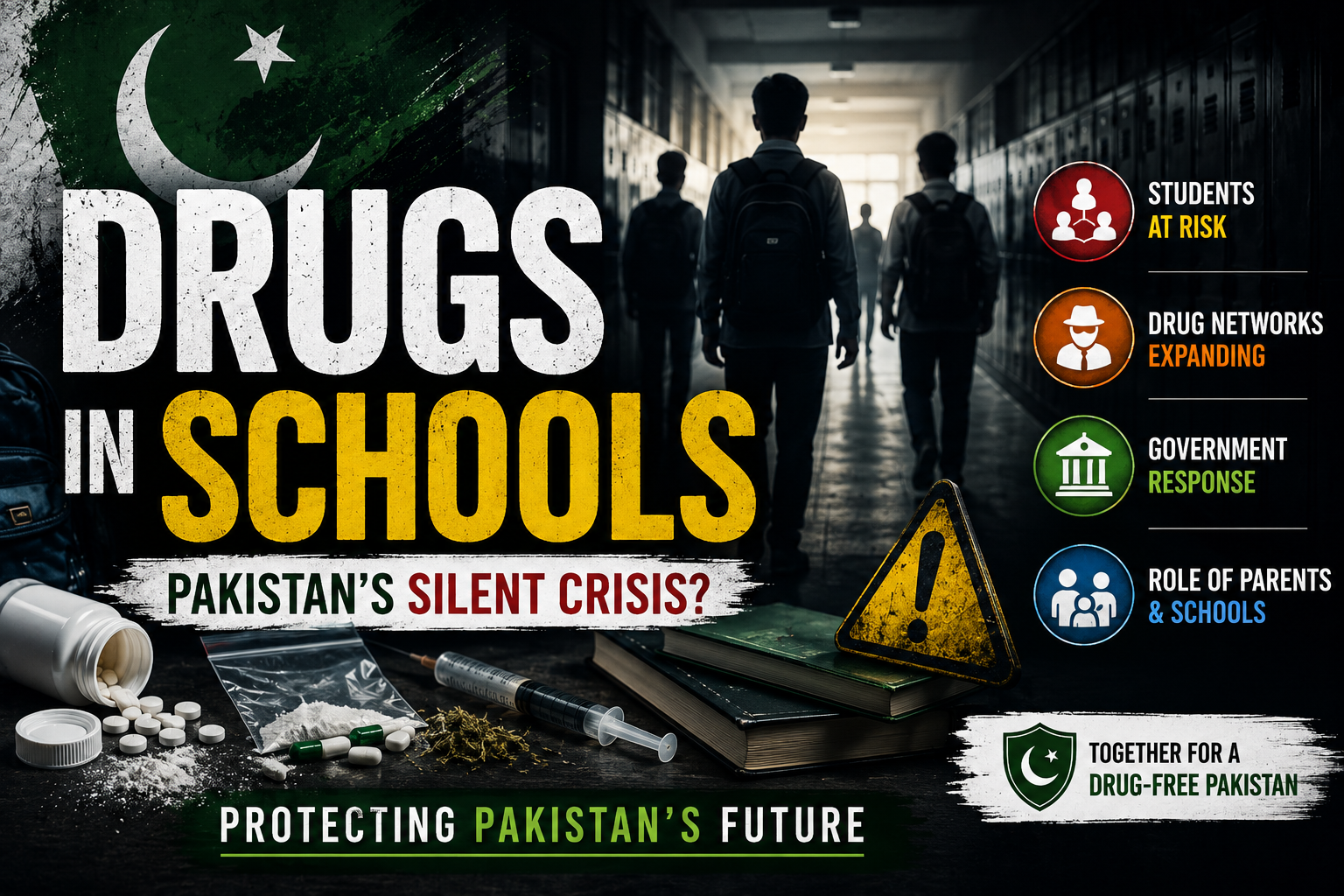
Drug abuse in Pakistan's schools is emerging as a serious challenge. Explore how narcotics reach students, the role of criminal networks, government responses, and what more can be done to protect the nation's youth.
JayJarwar Insights
6/18/20263 min read

Introduction
Education is often described as the foundation of a nation's future. Yet across Pakistan, concerns are growing about the increasing availability of narcotics and addictive substances among school and college students. What was once considered a problem largely confined to universities and urban nightlife has increasingly become a concern for younger age groups.
Parents, teachers, law enforcement agencies, and policymakers face a difficult question: how did drugs find their way into educational institutions, and what can be done to protect the country's youth?
The Nature of the Problem
Drug abuse among students is not limited to traditional narcotics. Reports from various parts of the country suggest that students may be exposed to a range of substances, including:
- Hashish and marijuana
- Crystal meth ("ice")
- Prescription medicines used without medical supervision
- Synthetic and designer drugs
- Nicotine products and vaping devices
The danger is not merely addiction. Drug abuse can lead to declining academic performance, mental health problems, family conflicts, violence, and increased involvement in criminal activities.
How Drugs Reach Students
Experts believe that drug distribution networks often target young people because they are more vulnerable to peer pressure and curiosity.
Common methods include:
Peer-to-Peer Distribution
Students may initially be offered substances by friends or acquaintances. What begins as experimentation can quickly develop into dependence.
Organized Criminal Networks
Law enforcement agencies have periodically reported arrests linked to organized groups involved in the sale and distribution of narcotics near educational institutions.
Social Media and Digital Platforms
Modern communication tools have made it easier for dealers to connect with potential customers while avoiding traditional street-level transactions.
Lack of Supervision
Schools with weak monitoring systems, inadequate counseling services, and limited engagement with parents may become more vulnerable to such activities.
Allegations of Protection and Influence
Whenever large-scale drug trafficking operations exist, questions often arise regarding corruption and protection networks. Media reports and anti-narcotics operations have occasionally highlighted concerns about influential individuals facilitating or protecting criminal activities.
However, proving such allegations requires evidence, investigations, and judicial proceedings. Without credible proof, accusations should be treated cautiously.
What remains clear is that drug trafficking is often highly organized and financially lucrative, making it difficult to combat through policing alone.
The Human Cost
The greatest victims are students and their families.
A student struggling with addiction may experience:
- Declining grades
- Behavioral changes
- Depression and anxiety
- Financial difficulties
- Health complications
- Increased risk of criminal involvement
For parents, the emotional and financial burden can be devastating.
Government Response
Pakistan's government and law-enforcement agencies have undertaken several measures to address the issue.
Anti-Narcotics Operations
The Anti-Narcotics Force (ANF) regularly conducts raids and investigations targeting drug suppliers and trafficking networks.
Awareness Campaigns
Educational institutions increasingly organize seminars and awareness sessions to educate students about the dangers of substance abuse
School Monitoring
Some provincial authorities have introduced inspections and monitoring mechanisms around educational institutions.
Legislative Measures
Existing narcotics laws provide severe penalties for trafficking and distribution, particularly when young people are targeted.
Challenges Facing Authorities
Despite these efforts, significant challenges remain:
- Limited rehabilitation facilities
- Social stigma surrounding addiction
- Resource constraints
- Cross-border trafficking routes
- Evolving distribution methods using digital platforms
These factors make enforcement difficult and require a broader strategy.
What More Can Be Done?
A comprehensive response should include:
Stronger School Counseling Systems
Every major school should have trained counselors capable of identifying early warning signs.
Parent Engagement
Parents must remain actively involved in their children's social circles and online activities.
Community-Based Prevention
Local communities, religious leaders, teachers, and civil society organizations should work together to raise awareness.
Rehabilitation and Recovery
Addiction should not be treated solely as a criminal issue. Accessible treatment and rehabilitation services are equally important.
Data-Driven Policy
Regular surveys and research can help policymakers understand the scale of the problem and design effective interventions.
Conclusion
The issue of drugs in educational institutions is not merely a law-enforcement challenge; it is a national concern that affects public health, education, and social stability. Protecting students requires cooperation among parents, schools, communities, and government agencies.
Pakistan's young population represents one of its greatest strengths. Ensuring that students grow up in safe, healthy, and drug-free environments is not only an educational priority but a national responsibility.
JayJarwar Insights
Ideas • Analysis • Perspectives
© 2026 JayJarwar Insights. All Rights Reserved.