Pakistan’s Economy Is Growing — So Why Is Poverty Still Rising?
Pakistan’s GDP grew 3.7% in FY2025–26, yet poverty rose to 28.9%. Explore why economic growth, jobs, inflation and living standards tell different stories.
By Jay Jarwar
7/15/20266 min read

Why GDP Growth Does Not Always Improve Living Standards
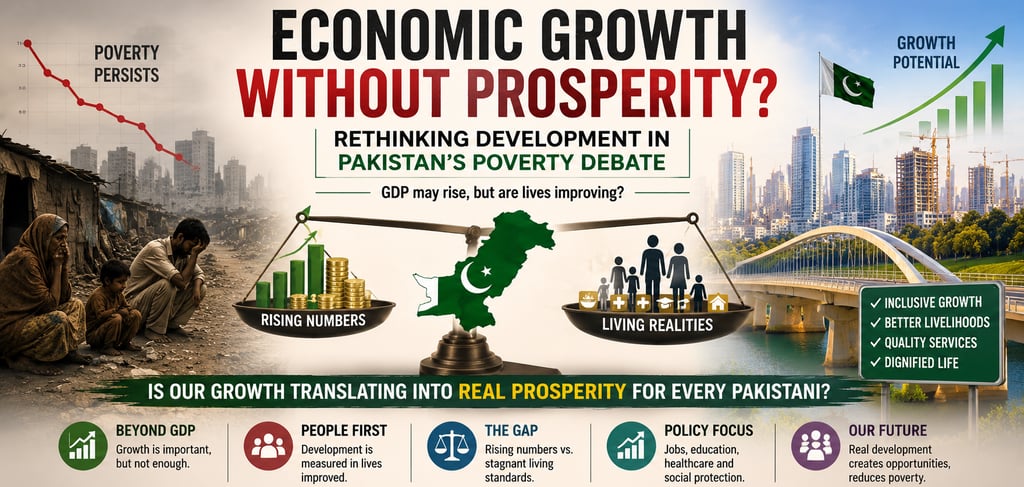
A country may report higher GDP, improved tax collection, larger exports, or record government revenues. On paper, these figures often suggest economic progress. Yet for millions of ordinary citizens, daily life may tell a very different story.
Pakistan’s latest economic data illustrate this tension clearly. The Pakistan Economic Survey 2025–26 reports real GDP growth of 3.7% and an increase in per-capita income to US$1,901. Yet the same period continues to show serious household pressures, including a national poverty headcount of 28.9% and unemployment of 7.1%.
If families struggle to afford food, healthcare, education, housing, and electricity despite positive economic statistics, an important question arises:
Is the country truly developing, or merely growing?
The debate has become even more significant after recent discussions surrounding Pakistan's poverty estimates, with different organizations presenting varying figures but reaching a similar conclusion: millions of Pakistanis continue to face serious economic hardship.
Economic Growth vs. Economic Development
Although the two terms are often used interchangeably, they describe very different concepts.
Economic growth refers to an increase in a country's total economic output, commonly measured by Gross Domestic Product (GDP). It answers the question:
Is the economy producing more goods and services than before?
Economic development, however, goes much further. It asks:
Are people becoming healthier?
Are incomes rising after inflation?
Are quality jobs being created?
Can families afford education and healthcare?
Is poverty declining?
Is the standard of living improving?
A nation may experience economic growth without achieving genuine economic development.
Real development is measured not by the wealth of a country alone, but by the well-being of its people.
Understanding Pakistan's Poverty Debate
Recently, Pakistan's poverty debate gained renewed attention after updated estimates from the World Bank suggested that a much larger share of the population falls below internationally defined poverty thresholds.
However, these figures require careful interpretation.
Pakistan now has newer poverty evidence. The Pakistan Economic Survey 2025–26, drawing on the Household Integrated Economic Survey 2024–25, reports that 28.9% of the population lives below Pakistan’s national poverty line, up from 21.9% in 2018–19.
The World Bank uses a different international benchmark. Its latest Poverty and Inequality Platform estimates that around 23% of Pakistan’s population lived below the US$3-a-day international poverty line in 2024. These figures should not be treated as contradictory because the national and international poverty lines use different thresholds and serve different purposes.
The important conclusion is not which single percentage should dominate the debate. Both measures show that a very large number of Pakistani households remain economically vulnerable despite the return of positive GDP growth.
Poverty estimates can differ substantially because national and international poverty lines use different thresholds, purchasing-power assumptions, and methodologies. The figures, therefore, answer different questions and should not be compared as if they were identical measures.
Although these figures differ, they all point toward one common conclusion:
Millions of Pakistani households continue to face significant economic hardship, making poverty reduction one of the country's most urgent policy challenges.
Inflation Has Reduced Purchasing Power
One of the biggest challenges confronting Pakistani households has been inflation. Inflation has moderated substantially from the extreme levels Pakistan experienced earlier in the decade, but price pressures have not disappeared. Pakistan Bureau of Statistics data show that consumer inflation was 9.2% year-on-year in July 2026, with prices rising 1.19% during that month alone. Lower inflation does not mean prices have returned to earlier levels; it means the rate at which prices are increasing has slowed.
Even where nominal salaries have increased, many workers have found that their purchasing power has declined because prices have risen faster than incomes.
Families now spend larger portions of their monthly earnings on:
Food
Electricity
Gas
Fuel
Rent
Medicines
School expenses
As a result, many households have reduced consumption, postponed healthcare, delayed education expenses, or accumulated debt simply to maintain basic living standards.
Growth Must Create Better Jobs
Economic growth matters most when it creates productive employment and rising real incomes. Pakistan Bureau of Statistics’ Labour Force Survey 2024–25 puts the unemployment rate at 7.1%, while average monthly wages were around Rs39,042. The labour-force participation rate stood at 46.3%.
These figures help explain why headline GDP recovery may not immediately translate into a sense of prosperity for every household. Growth can coexist with unemployment, underemployment, low wages, and weak labour-force participation.
When Taxation Becomes a Burden
Taxation is essential for every modern state.
Governments require revenue to finance infrastructure, education, healthcare, defence, and social welfare.
However, taxation must strike a careful balance.
When taxes increase while real incomes stagnate and inflation remains high, many citizens experience additional financial pressure.
Businesses face higher operating costs.
Consumers pay more for goods and services.
Investment slows.
The impact of taxation also depends on how revenue is raised. Taxes on income, property, consumption and essential goods can affect households very differently. The policy challenge is therefore not simply to collect more revenue, but to broaden the tax base fairly while protecting productive investment and ensuring that public revenue translates into better services.
Development Should Be Measured by Human Outcomes
Successful economies are rarely judged only by GDP growth.
Instead, policymakers increasingly evaluate progress through indicators such as:
Poverty reduction
Employment creation
Income growth
Educational attainment
Healthcare access
Housing affordability
Productivity
Social mobility
Pakistan’s human-development indicators show why GDP alone is insufficient. The UNDP Human Development Report 2025 places Pakistan 168th out of 193 countries, with an HDI value of 0.544 in the “low human development” category. When adjusted for inequality, Pakistan’s HDI falls by 33.1% to 0.364.
The picture is not uniformly negative. Pakistan’s latest household survey also records improvements in literacy, internet access, sanitation, immunisation and several other social indicators. The challenge is converting these gains into faster poverty reduction and broader economic security.
These measures provide a more complete picture of whether economic policies are improving people's lives.
Economic statistics are important.
Human well-being is even more important.
Pakistan's Long-Term Challenge
Pakistan possesses enormous economic potential.
A young population, strategic geographic location, expanding digital economy, growing IT exports, agriculture, manufacturing, and entrepreneurship all provide opportunities for sustained growth.
Pakistan therefore does not face a simple choice between growth and redistribution. It needs stronger and more sustained growth—but growth driven by productivity, investment, exports and job creation, alongside better education, healthcare, social protection and governance.
Related Reading: The Digital Economy: AI, Payments & E-Commerce in the Next Decade
The challenge is ensuring that economic expansion translates into broader prosperity.
Growth should generate productive employment.
Inflation should remain manageable.
Public services should improve.
Private investment should expand.
Most importantly, ordinary citizens should experience tangible improvements in their daily lives.
Only then does economic growth become genuine economic development.
Related Reading: The Demographic Divide: How Population Growth and Ageing Are Reshaping the World
Conclusion: Development Must Be Felt, Not Just Measured
Pakistan’s economy returned to stronger growth in FY2025–26, and macroeconomic stabilisation is important. But GDP growth of 3.7% cannot by itself answer whether development is succeeding when national poverty remains 28.9%, unemployment is 7.1% and Pakistan remains in the low human-development category.
Whether Pakistan's poverty rate is closer to the official estimate or higher under international and independent methodologies, the central policy challenge remains unchanged: economic growth must translate into better living standards for ordinary citizens. Real development is not measured only by GDP or tax collection—it is measured by whether people can afford food, healthcare, education, housing, and a dignified life.
Its true measure lies in whether citizens can live healthier, more secure, and more prosperous lives.
A growing economy is valuable.
A developing society is even more valuable.
Ultimately, the objective of public policy should not simply be to increase national income—it should be to improve the quality of life of the people who create that income.
Because real development is not measured by statistics alone.
It is measured by the dignity, opportunity, and prosperity experienced by every citizen.
Key Takeaways
Pakistan recorded real GDP growth of 3.7% in FY2025–26, while per-capita income rose to US$1,901.
The latest official household survey places national poverty at 28.9%, compared with 21.9% in 2018–19.
Inflation has moderated from previous peaks, but July 2026 CPI was still 9.2% year-on-year.
Unemployment, household purchasing power and unequal access to opportunity help explain why economic recovery may not immediately feel like prosperity.
Sustainable development requires not only GDP growth but better jobs, education, healthcare, productivity and stronger institutions.
About the Author
Jay Jarwar is the founder and editor of JayJarwar Insights. He writes about artificial intelligence, technology, geopolitics, economics, public policy and emerging global trends, with a focus on explaining complex issues in clear and accessible language.
JayJarwar Insights
Ideas • Analysis • Perspectives
© 2026 JayJarwar Insights. All Rights Reserved.