
NCP Vehicles in Pakistan: From Border Trails to Customs Auctions
What appears to be just another vehicle on the road may actually be part of a much larger story involving smuggling networks, influential interests, and law enforcement efforts. This article takes you inside the world of NCP vehicles and the ongoing battle by Pakistan Customs to protect the country's economic interests.
6/12/20263 min read
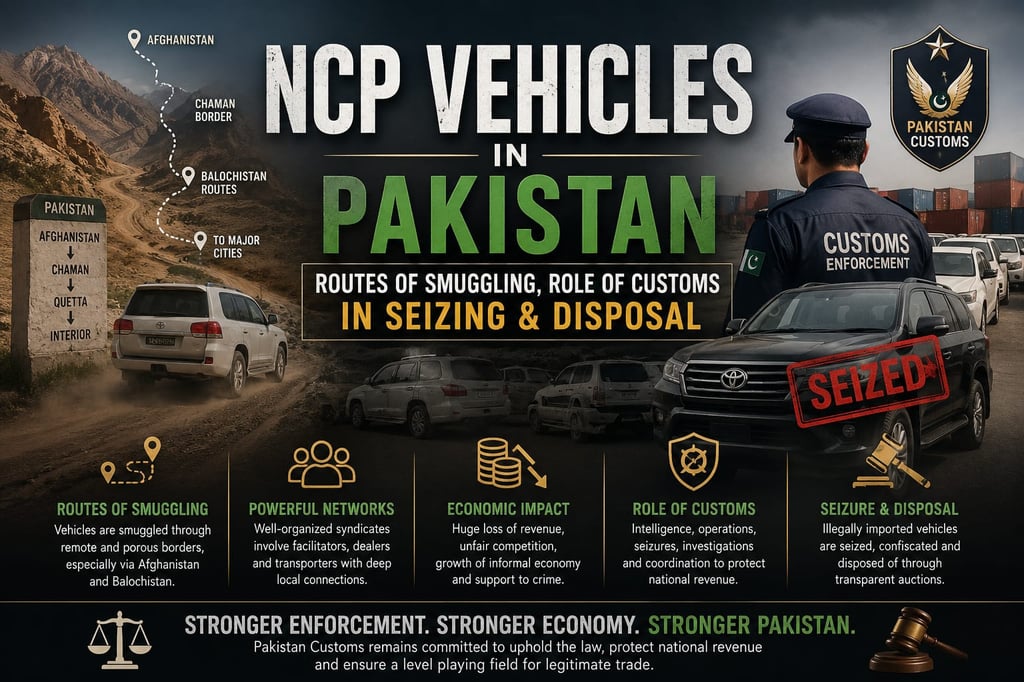
Imagine driving through a city and spotting a luxury SUV worth millions of rupees being sold at a surprisingly low price. The explanation often heard is simple: "It's an NCP vehicle."
For decades, Non-Customs Paid (NCP) vehicles have remained one of Pakistan's most visible symbols of smuggling. Behind every NCP vehicle lies a complex story of porous borders, organized smuggling networks, revenue losses, and the continuous efforts of Pakistan Customs to enforce the law.
What Exactly is an NCP Vehicle?
An NCP vehicle is a vehicle that enters Pakistan without payment of the applicable customs duties and taxes. Since vehicle import duties can be substantial, smugglers often attempt to bypass legal import channels and bring vehicles into the country illegally.
The result is a vehicle that may look legitimate on the road but has never contributed a single rupee to the national exchequer.
The Journey of a Smuggled Vehicle
The story often begins far from Pakistan's major cities.
Historically, many smuggled vehicles entered through border regions adjoining Afghanistan and remote areas of Balochistan. Rugged mountains, vast deserts, and sparsely populated regions provided opportunities for organized smuggling groups.
A vehicle may enter through an informal crossing point, be moved through a network of handlers, transported to urban centers, and eventually sold to an unsuspecting—or sometimes fully aware—buyer.
In some cases, smugglers have attempted to disguise the origin of vehicles through forged documents, fake registration plates, or fraudulent ownership records.
By the time the vehicle reaches a major city, tracing its true history can become a difficult task.
Why is it a Serious Problem?
Many people see NCP vehicles merely as "cheap cars." In reality, the issue affects the entire economy.
When a vehicle enters illegally:
The government loses customs duties and taxes.
Honest importers face unfair competition.
The informal economy expands.
Regulatory controls are weakened.
Criminal networks receive financial support.
A single vehicle may represent millions of rupees in evaded duties. Multiply that by hundreds or thousands of vehicles, and the financial impact becomes significant.
Customs: The Frontline Against Vehicle Smuggling
This is where Pakistan Customs enters the picture.
Contrary to popular perception, Customs enforcement does not end at ports and border stations. Intelligence units, Anti-Smuggling Organizations (ASO), field formations, and enforcement teams continuously monitor suspicious movements and investigate illegal trade activities.
Customs officers conduct:
Intelligence-based operations.
Roadside checks.
Document verification.
Market surveillance.
Joint operations with other law-enforcement agencies.
Many successful seizures begin with a simple piece of intelligence, a suspicious registration record, or a tip-off regarding vehicle movement.
From Seizure to Confiscation
When Customs suspects a vehicle to be non-customs paid, the vehicle may be detained for verification.
Officers examine:
Import records.
Chassis and engine numbers.
Registration documents.
Ownership history.
If legal importation cannot be established, adjudication proceedings are initiated under the Customs Act.
After due process, the vehicle may be confiscated by the state.
What Happens After Confiscation?
A common question people ask is:
"Where do all the seized vehicles go?"
The answer is simple: many eventually reach public auctions.
After completion of legal formalities, confiscated vehicles may be auctioned through transparent procedures. These auctions serve two important purposes:
They generate revenue for the government.
They prevent seized assets from remaining idle.
In some cases, vehicles may be allocated to government departments in accordance with applicable rules.
Thus, the story of an NCP vehicle often ends very differently from how it began—what entered the country illegally may ultimately be sold through a lawful public auction.
The Continuing Challenge
Despite advances in surveillance, databases, and enforcement techniques, the fight against vehicle smuggling remains challenging.
Smugglers constantly adapt their methods. Border geography, forged documentation, and financial incentives continue to create opportunities for illegal trade.
Yet every seizure, every investigation, and every successful prosecution sends an important message:
The rule of law still matters.
Conclusion
Despite advances in surveillance, intelligence gathering, and enforcement mechanisms, the fight against vehicle smuggling remains a difficult task.
One of the less discussed aspects of anti-smuggling operations is the pressure faced by field Customs officers. Unlike ordinary law enforcement cases, NCP vehicle networks often involve financially influential individuals, dealers, transporters, facilitators, and other well-connected persons who have a direct financial interest in the illegal trade.
Field officers conducting seizures and investigations may sometimes face:
Social and political pressure.
Influence from influential persons.
Requests for "leniency" from various quarters.
Threatening or intimidating calls from unknown or private numbers.
Attempts to discourage enforcement actions through informal channels.
In certain situations, officers may also encounter pressure arising from personal relationships, local influence networks, or vested interests seeking to protect smugglers and illegal traders. Such circumstances can make enforcement significantly more challenging than what is visible to the public.
The reality is that anti-smuggling operations often require not only professional competence but also considerable personal courage. Officers working in the field frequently make difficult decisions under pressure while balancing legal requirements, personal security concerns, and operational responsibilities.
For anti-smuggling efforts to succeed, enforcement personnel must be provided institutional support, legal protection, modern resources, and a transparent accountability framework. Strong institutions are built when officers are empowered to enforce the law without fear, favor, or external interference.
Ultimately, the effectiveness of Customs enforcement depends not only on laws and technology but also on the integrity and resilience of the officers tasked with implementing them.
JayJarwar Insights
Ideas • Analysis • Perspectives
© 2026 JayJarwar Insights. All Rights Reserved.