
Pakistan's Solar Revolution: A People's Answer to the Energy Crisis
Pakistan's solar boom is reshaping electricity costs and the power grid. Explore 2026 solar capacity, rooftop adoption, net-metering changes, and what comes next.
By Jay Jarwar
6/13/20266 min read

Introduction: Can Solar Solve Pakistan’s Energy Crisis?
For decades, Pakistan's energy sector has struggled with rising electricity tariffs, circular debt, fuel import dependence, and periodic power shortages. Households and businesses alike have faced the burden of soaring electricity bills, forcing many to search for alternatives.
Over the last few years, households, businesses, farms and institutions across Pakistan have increasingly turned to rooftop and off-grid solar.
What began as a niche technology for affluent households has evolved into one of the most striking examples of consumer-led solar adoption in an emerging economy. Today, solarization is rapidly reshaping Pakistan's energy landscape and raising an important question: Can solar energy become the long-term solution to Pakistan's energy crisis?
Pakistan's Solar Boom in 2026
Pakistan's solar boom has been remarkable. By 2026, Pakistan's solar boom had evolved from a household cost-saving trend into a major structural shift in the country's electricity system.
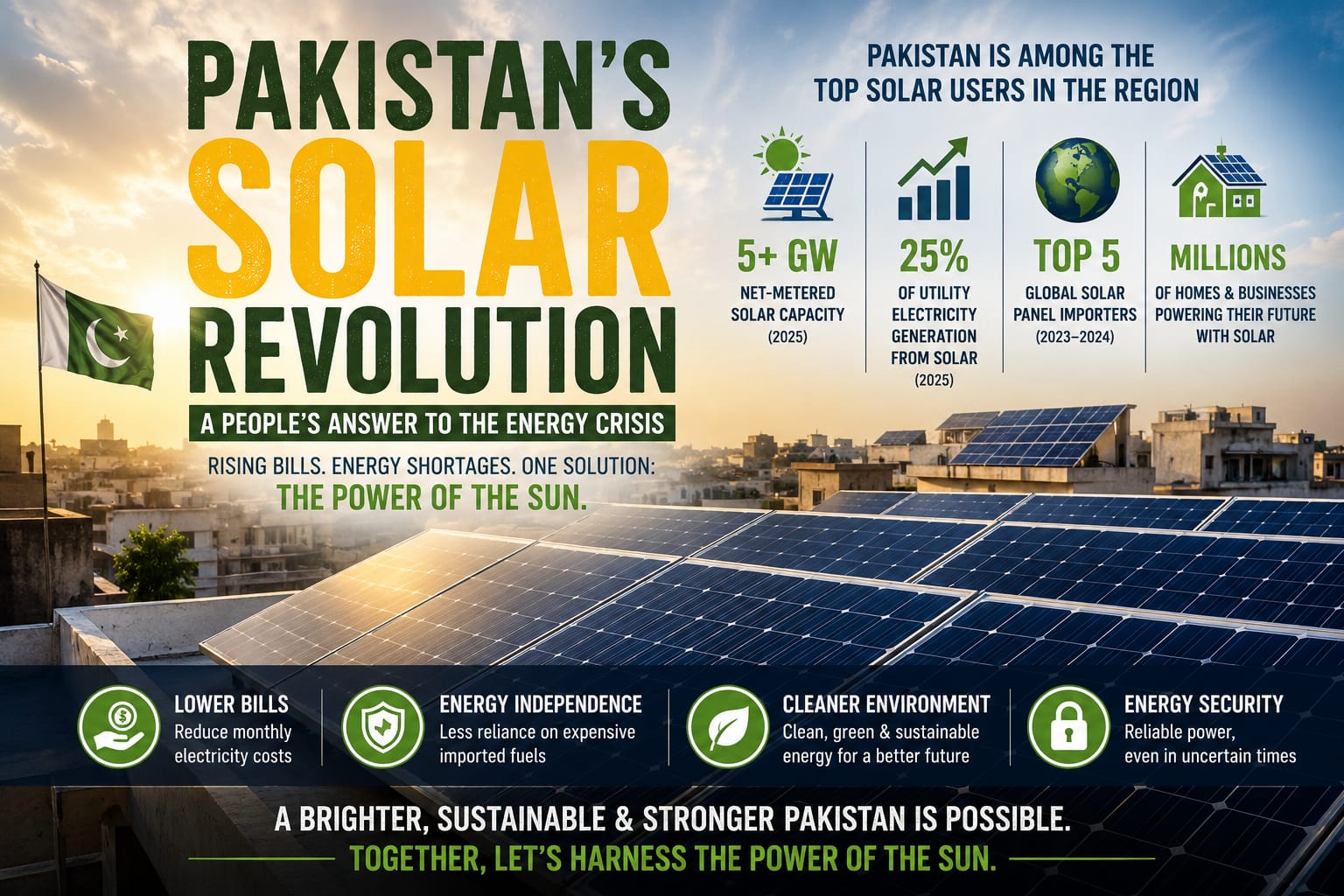
Pakistan’s solar expansion has accelerated at an extraordinary speed. According to the [Pakistan Economic Survey 2025–26], net-metered generation capacity had reached approximately 7,319 MW by March 2026—more than doubling from 2,813 MW a year earlier.
The International Energy Agency estimates that Pakistan added around 10 GW of solar PV capacity during 2025 alone, with the expansion driven almost entirely by on-grid and off-grid distributed systems. That places Pakistan among the world’s fastest-growing solar markets.
The speed of the transition was visible in early 2025. Ember data reported by Reuters showed that solar supplied an average of 25.3% of Pakistan’s utility electricity during the first four months of 2025, placing the country among a relatively small group of nations where solar reached at least one-quarter of monthly utility electricity supply.
Why Are Pakistanis Turning to Solar?
The answer is simple: economics.
For many households, monthly electricity bills have become a significant financial burden. Rising tariffs, fuel adjustment charges, taxes, and concerns about power reliability have encouraged consumers to seek alternatives.
Related Reading: Economic Growth Without Prosperity? Rethinking Development in Pakistan’s Poverty Debate
Falling equipment costs have reinforced that incentive. The IEA reported that Pakistan imported an estimated 19 GW of solar modules in 2024 alone—equivalent to roughly half of the country’s grid-connected generation capacity at the time. The combination of inexpensive imported panels and expensive grid electricity dramatically changed the economics of household and commercial solar.
Solar offers several advantages:
Lower electricity bills.
Protection from future tariff increases.
Greater energy independence.
Reduced dependence on imported fuels.
Cleaner and environmentally friendly power.
For many families and businesses, a one-time investment in solar panels can provide savings for years to come. As solar panel prices declined globally, adoption accelerated across Pakistan.
A People's Movement, Not a Government Program
What makes Pakistan's solar story unique is that much of the transition has been driven by ordinary citizens and businesses rather than large government projects.
Homeowners, shopkeepers, factories, schools, hospitals, and farms have increasingly installed rooftop solar systems to escape rising energy costs.
In many urban centers, solar panels have become as common a sight as water tanks on rooftops.
This decentralized approach has transformed consumers into producers of electricity, fundamentally changing how energy is generated and consumed in Pakistan.
IRENA cites expert estimates suggesting that distributed solar systems—including rooftop, captive, and off-grid installations—had reached around 15 GW by 2024. The organisation estimates that Pakistan’s solar expansion supported approximately 180,000 jobs, particularly in equipment sales, distribution, and installation.
The Benefits of Solarization
The solar boom has produced several positive outcomes:
Reduced Energy Costs
Households and businesses can significantly reduce their monthly electricity expenses.
Lower Fuel Imports
Pakistan spends billions of dollars annually on imported oil, gas, and fuel. Greater solar generation can reduce daytime demand for imported fuel-based electricity, although the overall effect on Pakistan’s energy import bill also depends on gas, oil, transport, and industrial demand.
Environmental Benefits
Solar energy produces electricity without direct operational greenhouse-gas emissions, contributing to cleaner air and climate goals.
Energy Security
Distributed solar can reduce daytime demand from the grid and give equipped households and businesses greater resilience during supply interruptions. However, rapid solar growth also creates new challenges for grid balancing, revenue recovery, and system planning.
Solar Success Is Creating a Grid Challenge
Pakistan’s solar boom is solving one energy problem while creating another. As more consumers generate their own electricity during daylight hours, traditional grid demand changes rapidly. Distribution companies must still maintain transmission lines, substations and generation commitments even when some of their highest-consuming customers purchase less electricity from the grid.
That makes grid modernisation increasingly urgent. In July 2026, the World Bank approved US$375.9 million for Pakistan’s Grid Stability Enhancement Project, part of a longer-term programme designed to strengthen the transmission network, reduce outages and enable greater integration of clean electricity.
The challenge is therefore no longer simply installing more solar panels. Pakistan must develop a power system capable of managing large amounts of decentralised, variable generation.
A Revolution Not Everyone Can Afford
Pakistan’s solar transition also raises an equity question. Not every household owns a rooftop, has enough savings to purchase panels and batteries, or lives in a property where solar can easily be installed. Renters, apartment residents and lower-income households may remain dependent on the grid even as wealthier consumers reduce their electricity purchases.
This creates a difficult policy balance. Solar users should be encouraged to invest in clean energy, but the cost of maintaining the national electricity network must also be distributed fairly among consumers who continue to depend on it.
The government has already acknowledged this tension. Changes to net-metering policy have been justified partly on the grounds that rapidly increasing distributed generation can shift some fixed grid costs toward consumers who remain fully dependent on conventional electricity supply.
Is Solar a Complete Solution?
While solar energy offers tremendous benefits, it is not a complete cure for all energy-sector problems.
Several challenges remain:
Solar generation depends on sunlight.
Battery storage adds significant upfront cost for many households and businesses.
The national grid requires modernisation.
Net-metering policies continue to evolve.
Power distribution companies face financial pressures as more consumers reduce grid consumption.
Pakistan’s regulatory framework is also evolving. NEPRA introduced new Prosumer Regulations in February 2026 and subsequently amended them during the year, reflecting the need to adapt electricity-market rules as distributed generation expands.
The Road Ahead
Pakistan's solar revolution demonstrates the power of market-driven innovation. Faced with expensive electricity and unreliable supply, citizens did not wait for perfect solutions. They invested in their own energy future.
The country's rapid solar adoption has already changed the conversation from "Can solar work in Pakistan?" to "How can Pakistan manage and maximise its solar future?"
Pakistan’s next energy challenge is therefore integration rather than adoption. The country has already demonstrated that households and businesses will install solar rapidly when the economics are attractive. What remains is to combine distributed solar with modern grids, battery storage, fair electricity pricing, and financially sustainable utilities.
Related Reading: Beyond the Strait of Hormuz: Why Gulf Nations Are Quietly Redrawing the Global Energy Map
Final Perspective: Pakistan Has Chosen Solar — Now the Grid Must Catch Up
Pakistan’s solar revolution is no longer a prediction. It is already reshaping how households, businesses, and farms produce and consume electricity. With thousands of megawatts of net-metered capacity and even larger amounts of distributed solar operating behind the meter, consumers have become active participants in the country’s energy transition.
But solar alone cannot repair Pakistan’s electricity sector. Transmission constraints, circular debt, pricing distortions, grid reliability, and unequal access to energy remain major challenges.
The next phase must therefore move beyond simply installing more panels. Pakistan needs a power system capable of integrating solar fairly, efficiently and reliably while ensuring that households unable to install their own systems are not left carrying an increasingly disproportionate share of grid costs.
The rooftops of Pakistan are already becoming power stations. The question now is whether the electricity system beneath them can evolve just as quickly.
Key Takeaways
Pakistan’s official net-metered generation capacity reached approximately 7,319 MW by March 2026.
The IEA estimates Pakistan added around 10 GW of solar PV during 2025, driven overwhelmingly by distributed systems.
Cheap imported panels and high grid electricity costs have made solar economically attractive for households and businesses.
Rapid distributed generation can reduce daytime grid demand but also creates challenges for grid stability, utility finances and fair cost-sharing.
Pakistan’s next solar challenge is no longer adoption alone—it is grid modernisation, storage, regulation and equitable access.
Sources & Further Reading
About the Author
Jay Jarwar is the founder and editor of JayJarwar Insights. He writes about artificial intelligence, technology, geopolitics, economics, public policy and emerging global trends, with a focus on explaining complex issues in clear and accessible language.
JayJarwar Insights
Ideas • Analysis • Perspectives
© 2026 JayJarwar Insights. All Rights Reserved.