
"Rs. 40,700 Minimum Wage: Relief for Workers or Still Not Enough?"
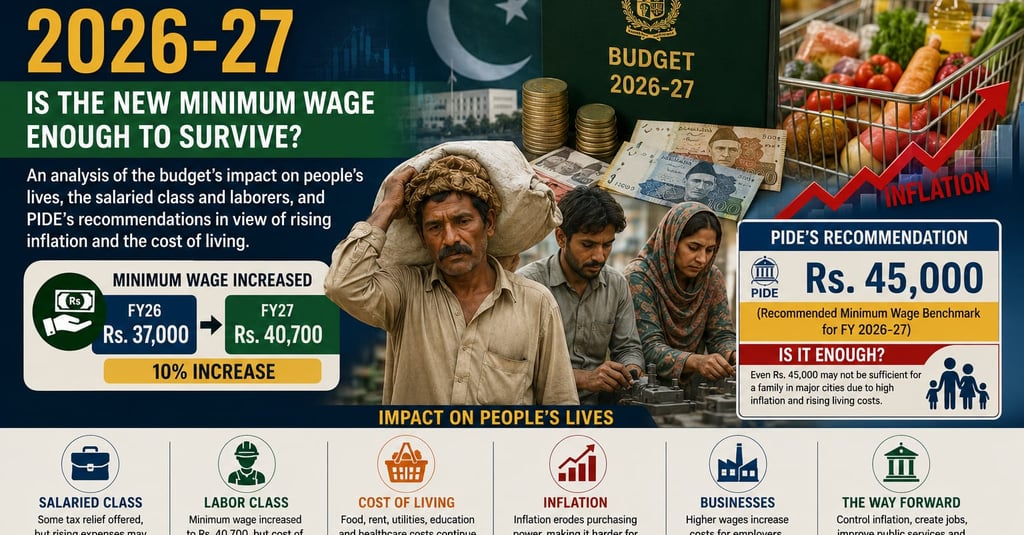
Pakistan's Budget 2026-27 raises the minimum wage from Rs. 37,000 to Rs. 40,700, but rising inflation continues to squeeze household budgets. This article analyzes the budget's impact on workers, the salaried class, businesses, and whether the increase is enough to help families make ends meet.
JayJarwar Insights
6/15/20264 min read

Introduction
Pakistan's Federal Budget 2026-27 has once again sparked debate about the cost of living, worker welfare, and the financial pressures facing ordinary citizens. While governments often highlight economic growth targets, revenue collection, and development spending, most Pakistanis judge a budget by a much simpler standard: "Will it make life easier?"
For millions of salaried employees, laborers, pensioners, and small business owners, the answer depends largely on whether their incomes can keep pace with rising prices.
One of the most discussed measures in the budget is the increase in the minimum wage from Rs. 37,000 to Rs. 40,700 per month—a rise of approximately 10 percent. While this increase may appear significant on paper, an important question remains: Is it enough to help workers make ends meet in an era of persistent inflation?
Relief for the Salaried Class
The budget includes some tax relief for salaried individuals, a segment that has long argued it bears a disproportionate share of the country's tax burden.
Unlike many sectors where income remains undocumented, taxes on salaried employees are deducted directly from their earnings. Consequently, even modest tax reductions are welcomed by middle-income households.
However, many families are likely to find that whatever relief they receive is quickly offset by rising costs of:
Housing and rent
Electricity and gas bills
Fuel and transportation
Education expenses
Healthcare costs
Food and household essentials
As a result, many salaried households may experience only limited improvement in their overall financial situation.
The New Minimum Wage: A Step Forward?
The government's decision to raise the minimum wage from Rs. 37,000 to Rs. 40,700 represents a 10 percent increase for fiscal year 2026-27.
The objective is clear: to provide greater protection to low-income workers facing rising living costs.
For workers earning the minimum wage, any increase is undoubtedly welcome. Yet the real issue is not whether wages have increased, but whether they have increased enough.
A minimum wage should ideally allow a worker and his or her family to meet basic needs with dignity. These needs include:
Food and nutrition
Rent
Utility bills
Transportation
Healthcare
Education
Clothing and household necessities
When these expenses are considered together, questions naturally arise about whether Rs. 40,700 can realistically support a family, particularly in Pakistan's larger cities.
PIDE's Alternative View
Interestingly, the Pakistan Institute of Development Economics (PIDE) had recommended a minimum wage benchmark of Rs. 45,000 per month for FY 2026-27.
PIDE argued that wage determination should be based on objective economic indicators rather than political considerations alone. Its proposed framework considered:
Inflation trends
Household needs
Worker purchasing power
Business affordability
Labor market realities
Compliance and enforceability
The recommendation reflected an attempt to align wages more closely with actual living costs faced by workers.
Is Even Rs. 45,000 Enough?
Perhaps the most important question is whether even PIDE's recommended figure of Rs. 45,000 would have been sufficient.
For many urban households, the answer may still be no.
Consider a modest monthly budget for a low-income family:
Rent: Rs. 15,000–25,000
Electricity, gas, and utilities: Rs. 5,000–10,000
Food and groceries: Rs. 20,000–30,000
Transportation: Rs. 3,000–8,000
Education and healthcare: Variable but increasingly expensive
Even conservative estimates suggest that basic household expenses can easily exceed Rs. 45,000 per month.
This means that while Rs. 45,000 would certainly have provided more relief than Rs. 40,700, it may still fall short of ensuring a comfortable or financially secure standard of living for many families.
Inflation: The Silent Tax
One of the biggest challenges facing workers today is inflation.
Even when wages increase, purchasing power can decline if prices rise faster than incomes.
Over recent years, Pakistan has experienced inflationary pressures driven by:
Energy price adjustments
Currency depreciation
Global commodity price fluctuations
Fiscal constraints
Supply chain disruptions
In this environment, wage increases alone cannot guarantee improved living standards.
A worker receiving a 10 percent wage increase may see little real benefit if food prices, utility charges, and transportation costs rise by a similar or greater amount.
The Employers' Challenge
The discussion cannot focus solely on workers.
Businesses, particularly small and medium enterprises, also face mounting pressures.
Higher wages improve worker welfare but increase operating costs. Many businesses are already struggling with:
High electricity tariffs
Expensive financing
Sluggish economic activity
Regulatory compliance costs
Policymakers therefore face a delicate balancing act: improving worker incomes without imposing unsustainable burdens on employers.
Beyond Wage Increases
Improving living standards requires more than periodic wage adjustments.
Long-term solutions include:
Controlling Inflation
Stable prices protect purchasing power.
Affordable Housing
Lower housing costs can significantly reduce financial stress.
Better Public Services
Quality education, healthcare, and transportation reduce household expenses.
Job Creation
A growing economy creates better employment opportunities.
Skills Development
Higher productivity allows workers to command better wages.
Conclusion
The increase in Pakistan's minimum wage from Rs. 37,000 to Rs. 40,700 is a positive step and will provide some relief to low-income workers. However, the broader debate reveals a deeper economic reality.
PIDE's recommendation of Rs. 45,000 suggested that living costs may require a higher wage floor than what has been approved. Yet even that figure may not fully address the challenges faced by urban working-class families struggling with inflation and rising household expenses.
Ultimately, the success of the 2026-27 budget will not be measured by fiscal targets alone. It will be measured by whether ordinary Pakistanis can afford food, housing, education, healthcare, and a dignified standard of living.
For many citizens, the question remains open: Has income growth truly caught up with the cost of living, or are workers still running to stay in the same place?
JayJarwar Insights
Ideas • Analysis • Perspectives
© 2026 JayJarwar Insights. All Rights Reserved.