
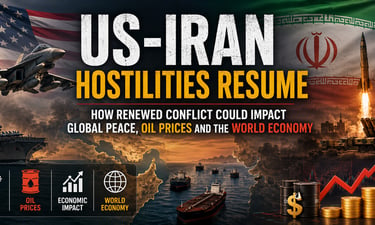
US-Iran Hostilities Resume: How Renewed Conflict Could Impact Global Peace, Oil Prices and the World Economy
The fragile US-Iran peace has been shaken by renewed military strikes and rising tensions around the Strait of Hormuz. Explore what triggered the latest hostilities, their impact on global oil markets, world peace, diplomacy, and the international economy.
By Jay Jarwar
7/14/20265 min read

Introduction
After months of war, fragile ceasefires and repeated diplomatic efforts, direct military confrontation between the United States and Iran has again intensified. On August 30, 2026, U.S. forces struck Iranian missile launchers on Larak Island in the Strait of Hormuz. Iran responded with missile attacks against U.S. military positions in Jordan, renewing fears of another cycle of escalation.
The latest confrontation comes after more than six months of conflict that has already disrupted Gulf energy flows, reshaped shipping patterns and placed enormous pressure on regional diplomacy. The question is no longer whether U.S.–Iran confrontation can affect the wider world—it already has. The more important question is whether renewed fighting will deepen the economic and strategic consequences.
A Fragile Pause Gives Way to Renewed Fighting
The temporary understanding between Washington and Tehran was intended to create space for negotiations that could eventually lead to a broader and more durable agreement. Although tensions never fully disappeared, many observers hoped the pause in hostilities would reduce the risk of another large-scale conflict.
That optimism has weakened dramatically.
Fresh military strikes, missile launches, and accusations from both sides have reignited fears that the region may once again be entering a dangerous cycle of retaliation.
The August escalation illustrates how difficult it has been to convert temporary reductions in fighting into a durable political settlement. Periods of relative calm have repeatedly been followed by renewed military exchanges, while negotiations over sanctions, shipping and regional security remain unresolved.
What Triggered the Renewed Fighting?
The latest escalation appears to have begun after incidents involving commercial shipping in and around the Strait of Hormuz, one of the world's most strategically important waterways.
The United States blamed Iran for attacks on vessels passing through the strait and responded with airstrikes against multiple military targets. Iran rejected the accusations, argued that the strikes violated previous understandings, and launched retaliatory attacks against American military positions and allied facilities across the Gulf region.
Both governments now claim they acted in self-defense, while each accuses the other of breaking the terms of the temporary agreement.
The latest round began on August 30, when U.S. forces struck two Iranian missile launchers on Larak Island. U.S. officials said Iranian forces were preparing potential mining operations in the Strait of Hormuz. Iran subsequently launched ballistic missiles toward U.S. military facilities in Jordan.
Why the Strait of Hormuz Matters
The Strait of Hormuz is one of the most important maritime routes on Earth.
A significant portion of global oil exports and liquefied natural gas shipments passes through this narrow waterway every day. The International Energy Agency estimates that around 20 million barrels per day of crude oil and petroleum products passed through Hormuz in 2025—about one-quarter of global seaborne oil trade. The Strait also carried LNG exports from Qatar and the UAE, representing roughly 19% of global LNG trade.
The 2026 conflict demonstrated the consequences of disrupting that chokepoint. The IEA described the resulting oil-supply shock as the largest in the history of the global oil market.
Even the possibility of disruption can immediately affect international energy markets.
Iran has repeatedly asserted greater control over shipping movements through the strait, while the United States maintains that freedom of navigation must remain protected under international law.
This disagreement has become one of the central flashpoints in the renewed confrontation.
Related Reading: Beyond the Strait of Hormuz: Why Gulf Nations Are Quietly Redrawing the Global Energy Map
Regional Tensions Are Expanding
The conflict is no longer limited to the United States and Iran.
Reports indicate that missile and drone activity has affected several Gulf countries, including Bahrain, Kuwait, Qatar, Jordan and Oman. Although many incoming threats were intercepted, the widening geographic scope demonstrates how rapidly regional crises can spread.
Several governments have strengthened security measures around military installations, ports and energy infrastructure while calling for restraint from all parties.
The latest escalation again demonstrates the regional nature of the conflict. Iranian retaliation has targeted U.S. military positions outside Iran, while Gulf states remain concerned about the security of ports, bases, shipping lanes and energy infrastructure.
Diplomacy Under Pressure
The renewed military exchanges have placed ongoing diplomatic efforts under enormous strain.
Indirect negotiations had been expected to resume following a pause connected to national mourning events in Iran. However, the latest attacks have complicated the political atmosphere, reducing trust between both sides.
Despite the deterioration, some mediators continue working behind the scenes to prevent the complete collapse of diplomatic contacts.
Whether negotiations can recover remains uncertain. Diplomatic channels have not disappeared. Iran and Oman have continued discussing arrangements for restoring navigation through the Strait of Hormuz, while broader negotiations remain tied to sanctions, security guarantees and the course of the war. But repeated military exchanges make each new round of diplomacy more difficult.
The United Nations has repeatedly called on both Iran and the United States to de-escalate, restore freedom of navigation through Hormuz and return to negotiations.
Economic Consequences Could Be Global
The economic effects remain visible. The August 2026 forecast of the U.S. Energy Information Administration says severe constraints on Hormuz transit continue to reduce Middle Eastern oil production and inventories. The EIA forecasts Brent crude to average around US$85 per barrel in the third quarter of 2026.
Related Reading: When Missiles Meet Markets: How the U.S.–Iran War Is Reshaping the Global Economy
Impact on Global Security
Beyond economics, prolonged confrontation carries broader security implications.
There is an increased possibility of cyber operations, attacks by regional proxy groups, disruption of international trade routes, and accidental military escalation involving additional countries.
Even if neither Washington nor Tehran seeks a full-scale war, repeated exchanges increase the risk that a single miscalculation could trigger a much larger conflict.
The greatest danger may therefore be escalation by miscalculation. When military forces, commercial shipping, regional bases and energy infrastructure operate within the same contested space, even a limited incident can produce political pressure for retaliation.
Can Diplomacy Still Prevail?
History shows that periods of intense confrontation have often been followed by renewed negotiations.
Military pressure may strengthen bargaining positions temporarily, but lasting stability usually depends on diplomacy rather than battlefield victories.
International mediators, regional partners and global institutions are therefore likely to intensify efforts aimed at restoring communication before the situation deteriorates further.
Diplomacy remains possible, but the events of 2026 show that temporary pauses are not the same as lasting settlements. Any durable agreement would need to address not only immediate military exchanges but also sanctions, freedom of navigation, regional security and the political conditions necessary to prevent another cycle of retaliation.
Final Perspective: Escalation Is Easy; Stability Is Harder
The U.S.–Iran conflict has already demonstrated how quickly a regional confrontation can affect international energy supplies, shipping, financial markets and security far beyond the Middle East.
Yet renewed fighting does not make unlimited escalation inevitable. Diplomatic channels remain open, global energy markets have shown some capacity to adjust, and regional governments have strong incentives to prevent a wider war.
The central challenge is converting temporary pauses into arrangements that can survive the next provocation.
The events of August 2026 are another reminder that military deterrence may stop an adversary temporarily, but lasting stability ultimately requires political agreements capable of preventing the next missile from being launched.
Sources & Further Reading
Reuters — U.S. Forces Strike Iranian Missile Launchers on Larak Island, August 2026
Reuters — U.S.–Iran Military Exchanges Resume, August 31, 2026
International Energy Agency — Strait of Hormuz Factsheet, 2026
U.S. Energy Information Administration — Short-Term Energy Outlook, August 2026
United Nations — Secretary-General Statement on Renewed Gulf Escalation and Diplomacy
Reuters — Iran and Oman Discuss Conditions for Restoring Strait of Hormuz Navigation
About the Author
Jay Jarwar is the founder and editor of JayJarwar Insights. He writes about artificial intelligence, technology, geopolitics, economics, public policy and emerging global trends, with a focus on explaining complex issues in clear and accessible language.
JayJarwar Insights
Ideas • Analysis • Perspectives
© 2026 JayJarwar Insights. All Rights Reserved.