
Argentina vs Spain FIFA World Cup Final 2026: Drama, Controversies and the Road to Football History
Argentina and Spain meet in the FIFA World Cup 2026 Final after dramatic semifinal victories. Explore the tournament's biggest moments, controversies and what makes this final one for the history books.
JayJarwar Insights
7/17/202610 min read
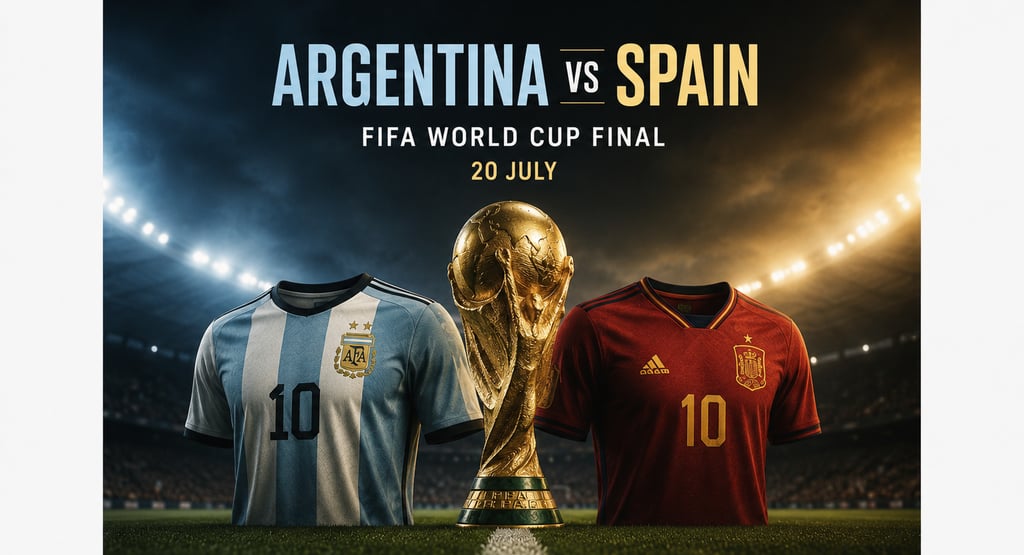
Argentina vs Spain: A World Cup Final for the Ages? Drama, Controversy and the Road to Football's Biggest Night
Introduction
Every FIFA World Cup creates unforgettable memories, but only a handful become defining chapters in football history.
The 2026 FIFA World Cup has delivered everything football fans could have hoped for—spectacular goals, emotional comebacks, emerging stars, tactical masterclasses and moments of intense controversy. From passionate celebrations to heartbreaking exits, the tournament has once again reminded the world why football remains the planet's most beloved sport.
Now, after weeks of captivating competition, only two teams remain.
Defending champions Argentina and European giants Spain will meet on 20 July in what promises to be one of the most eagerly anticipated World Cup finals in recent memory.
For Argentina, the match represents an opportunity to defend football's greatest prize and further cement one of the country's golden generations. For Spain, it offers a chance to reclaim the world title through a new generation of talented players who have impressed throughout the tournament.
Yet this World Cup has been about far more than football alone. It has sparked debates over refereeing decisions, VAR interventions, political commentary and the increasing pressure placed on match officials in the modern game.
Regardless of who eventually lifts the trophy, the 2026 FIFA World Cup has already left a lasting mark on football history.
A Tournament Filled with Emotion
From the opening match, the expanded 48-team tournament demonstrated football's growing global reach.
Traditional powerhouses faced determined underdogs.
Several pre-tournament favourites departed earlier than expected.
New footballing nations announced themselves on the biggest stage.
Packed stadiums across North America showcased football's expanding popularity, while millions of viewers around the world followed every dramatic twist.
As always, the World Cup reminded us that football is not merely about tactics or statistics.
It is about hope.
National pride.
Dreams.
And unforgettable moments that unite generations of supporters.
Spain's Road to the Final
Spain have arguably been among the tournament's most consistent performers.
Combining disciplined defending with intelligent possession-based football, they have demonstrated why they remain one of international football's most respected teams.
Their semifinal victory over France highlighted their tactical maturity.
Facing one of Europe's strongest sides, Spain maintained composure under pressure while taking advantage of key opportunities to secure a convincing victory.
Throughout the tournament they have displayed:
Excellent midfield control.
High pressing intensity.
Defensive organisation.
Clinical finishing.
Tactical flexibility.
Rather than relying on one superstar, Spain have succeeded through collective teamwork—a characteristic that has defined many of the country's greatest international successes.
Their place in the final has been earned through consistency rather than luck.
Argentina's Pursuit of History
Argentina entered the tournament carrying the expectations that come with being defending world champions.
Every opponent viewed defeating them as a statement victory.
Every match attracted enormous global attention.
Despite facing difficult moments, Argentina once again demonstrated the qualities that have made them one of football's most successful nations:
Resilience under pressure.
Tactical intelligence.
Individual brilliance.
Strong leadership.
Winning mentality.
Their dramatic semifinal victory over England captured the essence of championship football.
After falling behind, Argentina responded with determination, eventually overturning the deficit to book another place in the World Cup Final.
Such performances reinforce why experienced tournament teams are often so dangerous.
Champions rarely panic.
They adapt.
They persist.
And they find ways to win.
Drama Beyond the Scoreline
A Tournament That Sparked Global Debate
Every FIFA World Cup creates unforgettable moments, but the tournaments that endure in public memory are often remembered not only for the football played on the pitch but also for the debates that follow.
The 2026 FIFA World Cup has been no exception.
While the tournament has showcased outstanding football, it has also reignited discussions surrounding refereeing standards, the application of VAR, consistency in decision-making and even the intersection of politics and sport.
Such controversies are not unique to this World Cup. From Diego Maradona's famous "Hand of God" in 1986 to Frank Lampard's disallowed goal in 2010 and various VAR debates in recent tournaments, football has long wrestled with the challenge of balancing human judgement with technological assistance.
The difference today is that every decision is analysed instantly by millions of viewers through television broadcasts, social media and advanced replay technology.
VAR: Progress or Persistent Debate?
When the Video Assistant Referee (VAR) system was introduced, its objective was clear: reduce clear and obvious errors while improving fairness.
In many situations, VAR has undoubtedly corrected important mistakes.
Goals have been validated.
Offside decisions have become more precise.
Serious fouls have received closer scrutiny.
However, the system has also generated new questions.
Many supporters and former players argue that while technology has improved accuracy, it has not eliminated controversy.
Instead, debates have shifted from whether an incident occurred to how the laws of the game should be interpreted.
Questions frequently raised include:
When should VAR intervene?
What constitutes a "clear and obvious error"?
How much discretion should remain with the on-field referee?
Does lengthy review interrupt the rhythm of the match?
Different football communities often reach different conclusions, illustrating that technology alone cannot remove every element of subjectivity from officiating.
The Egypt Goal Debate
Among the tournament's most widely discussed moments was the disallowed Egyptian goal, which generated extensive debate among supporters, analysts and former players.
For many Egyptian fans, the decision represented a heartbreaking turning point.
Others argued that match officials applied the Laws of the Game as they interpreted them.
Regardless of where opinions differed, the incident highlighted how a single refereeing decision can influence not only the outcome of a match but also the emotions of millions of supporters worldwide.
Such moments are reminders that football's greatest beauty—and sometimes its greatest frustration—lies in the fine margins separating triumph from disappointment.
Politics Meets Football
Another widely discussed episode came after the U.S. President Donald Trump publicly commented on a refereeing decision, calling for a red card to be withdrawn.
The remarks generated considerable international media attention.
Supporters viewed the comments in different ways.
Some regarded them as passionate support for the game.
Others argued that refereeing decisions should remain entirely independent from political commentary.
Ultimately, FIFA's refereeing process remained unchanged, but the incident demonstrated how football's global popularity increasingly attracts attention far beyond the sporting world.
The World Cup today is not merely a football tournament.
It is also one of the world's largest cultural and media events.
Pressure on Modern Referees
Refereeing at the highest level has perhaps never been more demanding.
Modern officials operate under extraordinary scrutiny.
Every decision is examined from multiple camera angles.
Slow-motion replays reveal details invisible in real time.
Social media ensures that controversial moments spread globally within minutes.
While technology has provided valuable assistance, it has also raised expectations to an almost impossible standard of perfection.
Human judgement remains an essential part of football.
No technological system can completely eliminate disagreement over subjective decisions.
For this reason, many football experts continue to advocate improvements in referee communication, greater transparency in VAR reviews and clearer explanations of controversial rulings.
A Final Beyond the Trophy
Although discussions about officiating have dominated many headlines, they should not overshadow the extraordinary football displayed throughout the tournament.
The final between Argentina and Spain represents more than a contest between two outstanding national teams.
It also symbolizes two contrasting footballing philosophies.
Argentina have built their campaign on resilience, competitive spirit and the ability to produce decisive moments under pressure.
Spain have impressed through technical excellence, patient possession and collective teamwork.
Neither approach is inherently superior.
Both have earned their place through consistent performances against elite opposition.
This contrast makes the World Cup Final especially compelling.
It is not simply a battle between players.
It is also a meeting of footballing identities that have shaped the modern game.
Can Argentina Defend Their Crown?
The question dominating football discussions around the world is simple:
Can Argentina successfully defend the FIFA World Cup?
History suggests that defending the title is among the most difficult achievements in international football.
Every champion enters the next tournament carrying greater expectations and facing opponents determined to defeat them.
Argentina possess significant advantages.
Their squad combines experience, tactical discipline and the confidence that comes from previous success.
At the same time, Spain arrive with exceptional momentum, youthful energy and perhaps the tournament's most balanced overall performances.
On paper, there is remarkably little separating the two finalists.
A single moment of brilliance.
One defensive mistake.
A set piece.
Or perhaps even a penalty shootout.
Any of these could determine who lifts football's most prestigious trophy.
Rather than predicting the outcome, it may be more appropriate to appreciate the rarity of such a balanced final.
Whatever the result, football supporters can reasonably expect a contest worthy of the occasion.
A Final That Could Shape Football History
More Than a Trophy
When Argentina and Spain walk onto the pitch on 20 July, they will be competing for far more than the FIFA World Cup Trophy.
For Argentina, victory would mean successfully defending the world's greatest football title—an achievement accomplished by only a handful of nations in World Cup history. It would further strengthen the country's extraordinary football legacy and provide another unforgettable chapter for a generation that has already inspired millions.
For Spain, the final represents an opportunity to announce the arrival of another golden era. After years of rebuilding, La Roja have once again demonstrated why technical excellence, tactical discipline and collective football remain among the most admired philosophies in the sport.
For millions of supporters across the globe, however, the final is about something even greater.
It is about dreams.
National pride.
Childhood memories.
Generations united by ninety minutes of football.
This is what makes the FIFA World Cup unique.
The Legacy of the 2026 FIFA World Cup
Regardless of who becomes world champion, the 2026 FIFA World Cup has already secured its place among football's most memorable tournaments.
It has been a competition filled with:
Stunning upsets.
Last-minute drama.
Tactical masterclasses.
Emerging young stars.
Passionate supporters.
Heated refereeing debates.
Unforgettable emotional moments.
Related Reading: FIFA World Cup 2026: Giants Fall, Underdogs Rise and Football Wins Again
The expanded tournament introduced new footballing nations to the global stage while proving that international football continues to evolve.
Established giants were reminded that reputation alone guarantees nothing.
Emerging teams demonstrated that determination, preparation and belief can narrow the gap between traditional powers and ambitious newcomers.
Perhaps that is the tournament's greatest lesson.
Football continues to become more competitive with every generation.
Football's Greatest Winner: The Game Itself
Throughout this World Cup, millions celebrated victories.
Millions endured heartbreak.
Some dreams ended unexpectedly.
Others began for the first time.
Yet beyond every scoreline, one truth remained constant.
Football itself emerged as the greatest winner.
The tournament brought together cultures, languages and nations from every continent.
Children discovered new heroes.
Families celebrated together.
Old rivalries were renewed.
New stories were written.
Few sporting events possess the power to unite humanity in quite the same way.
For one month, political borders fade.
The language becomes universal.
Related Reading: Beyond the Pitch: Football Haircuts, Birthday Ideas, Watch Parties, Drills and Fan Lifestyle Inspiration
A football.
A goal.
A celebration.
The Road Now Leads to 2030
As the curtain falls on the 2026 FIFA World Cup, attention gradually shifts toward an even more historic occasion.
The 2030 FIFA World Cup will mark the 100th anniversary of the tournament, celebrating a century since the inaugural competition was held in Uruguay in 1930.
To commemorate this milestone, FIFA has adopted an unprecedented hosting model.
The main tournament will be jointly hosted by:
Morocco
Spain
Portugal
while special opening matches are planned in:
Uruguay
Argentina
Paraguay
paying tribute to South America's unique place in football history.
The centenary World Cup will become more than another tournament.
It will celebrate one hundred years of unforgettable moments—from Pelé and Maradona to Zidane, Ronaldo, Iniesta, Messi and countless other legends who transformed the game.
It will also symbolize football's remarkable journey from a regional competition into the world's most watched sporting event.
What the Future Holds
The next decade promises significant changes for international football.
Artificial intelligence may assist referees more effectively.
Semi-automated officiating systems will likely continue to improve.
Sports science will become even more influential.
Data analytics will reshape tactics.
Young talent will emerge from regions previously considered outsiders.
Yet despite these technological and tactical advances, one thing will almost certainly remain unchanged.
Football's greatest strength has never been technology.
It has always been emotion.
No algorithm can replicate the joy of a last-minute winner.
No statistic can fully explain the heartbreak of defeat.
No technology can replace the roar of thousands of supporters singing together inside a stadium.
That emotional connection is what makes football the world's game.
Key Takeaways
Argentina and Spain have earned their places in the final through outstanding performances.
The 2026 FIFA World Cup has combined exceptional football with moments of controversy and debate.
VAR continues to improve decision-making while generating new discussions about consistency and transparency.
The expanded World Cup highlighted the growing competitiveness of international football.
The 2030 FIFA World Cup will celebrate the tournament's centenary with a unique multi-continent hosting model.
Football's greatest legacy continues to be its ability to unite people across cultures and generations.
Frequently Asked Questions
When is the FIFA World Cup 2026 Final?
The FIFA World Cup 2026 Final is scheduled to be played on 20 July 2026 between Argentina and Spain.
How did Spain reach the final?
Spain secured their place by defeating France in the semifinal after displaying consistent performances throughout the tournament.
How did Argentina qualify for the final?
Argentina booked their place after a dramatic comeback victory over England, once again demonstrating the resilience expected of defending champions.
What were some of the biggest controversies of the tournament?
Among the most discussed moments were debates surrounding VAR decisions, Egypt's disallowed goal, refereeing consistency and the widespread attention generated by Donald Trump's public comments regarding a refereeing decision.
Where will the next FIFA World Cup be held?
The 2030 FIFA World Cup will be jointly hosted by Morocco, Spain and Portugal, while commemorative opening matches will take place in Uruguay, Argentina and Paraguay to celebrate the tournament's 100th anniversary.
Conclusion: Before the Final Whistle
Only one team will lift the FIFA World Cup.
Only one captain will raise football's most coveted trophy beneath a sky filled with confetti and celebration.
Yet when the final whistle blows on 20 July, the true legacy of the 2026 FIFA World Cup will extend far beyond the scoreboard.
It will be remembered for the courage of underdogs who challenged giants.
For moments of brilliance that left millions speechless.
For refereeing decisions that sparked passionate debate across continents.
For supporters who travelled thousands of miles simply to stand behind their nation.
And above all, it will be remembered for reminding the world why football remains the planet's most beloved sport.
Whether Argentina successfully defend their crown or Spain begin a new golden chapter, history will record only one champion.
But millions of fans will remember something far greater.
They will remember the emotions.
The celebrations.
The heartbreak.
The controversies.
The unforgettable moments that no statistics can fully capture.
As attention turns toward the centenary FIFA World Cup in 2030, one thing is already certain:
The beautiful game will continue to inspire new generations, create new heroes and unite the world—one match, one goal and one unforgettable story at a time.
JayJarwar Insights
Ideas • Analysis • Perspectives
© 2026 JayJarwar Insights. All Rights Reserved.