
Spain Crowned World Champions: How a Tactical Masterclass Ended Argentina's Reign at FIFA World Cup 2026
Spain defeated Argentina 1–0 after extra time to win the FIFA World Cup 2026. Explore the tactical battle, decisive moments, standout performances and what the result means for football's future.
JayJarwar Insights
7/19/20264 min read

Introduction
The curtain has fallen on another unforgettable FIFA World Cup.
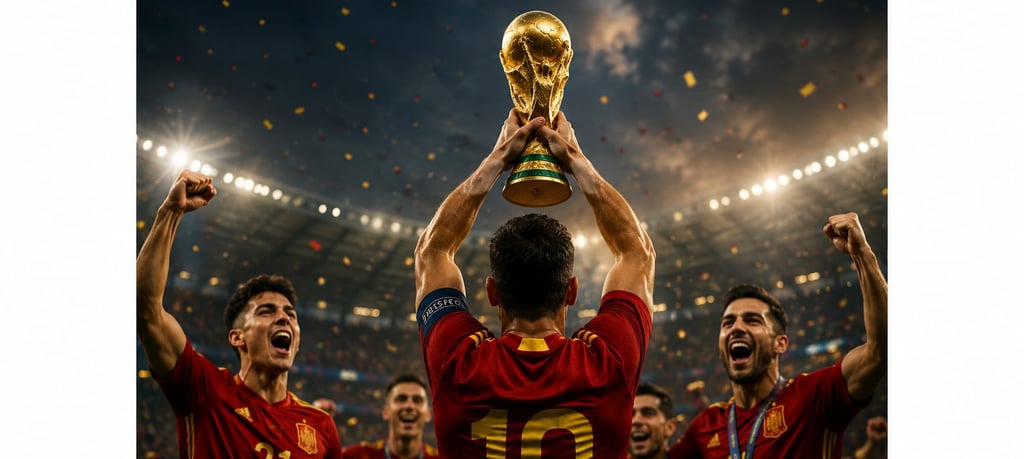
In a final that lived up to its enormous expectations, Spain defeated defending champions Argentina 1–0 after extra time, reclaiming football's greatest prize through discipline, patience and tactical excellence. The decisive moment came in the 106th minute, when Ferran Torres found the breakthrough that separated two outstanding teams after more than 100 minutes of relentless competition.
For Spain, it marked a return to the summit of world football and the beginning of what many believe could become another golden era. For Argentina, it was a heartbreaking end to a remarkable campaign that nevertheless reinforced their status as one of international football's greatest powers.
Beyond the trophy, however, the 2026 FIFA World Cup will be remembered for its unforgettable drama, controversial moments, emotional farewells and a tournament that once again united billions of people through the universal language of football.
A Final Worthy of the Occasion
The match delivered exactly what football supporters had hoped for.
Rather than an open, high-scoring contest, the final became a fascinating tactical battle in which every pass, defensive adjustment and substitution mattered.
Spain controlled long periods of possession, patiently circulating the ball and forcing Argentina to defend with discipline.
Argentina, meanwhile, relied on their trademark resilience, compact defending and quick transitions whenever opportunities appeared.
Neither side was willing to take unnecessary risks.
Related Reading: The dramatic final was the perfect conclusion to a tournament filled with unexpected upsets and unforgettable moments. To revisit how the competition unfolded from the group stage to the knockout rounds, read our in-depth analysis: "FIFA World Cup 2026: Giants Fall, Underdogs Rise and Football Wins Again."
As a result, clear scoring chances remained limited throughout normal time.
The deadlock reflected the quality of both teams far more than any lack of attacking ambition.
The Decisive Moment
When fatigue began to affect both sides during extra time, Spain finally found the breakthrough.
A well-worked attacking move created just enough space for Ferran Torres, whose composed finish in the 106th minute proved decisive.
Argentina pushed forward desperately during the closing stages.
Their attacking substitutions increased pressure.
Long balls entered the penalty area.
Set pieces created moments of hope.
But Spain's defence remained organised until the final whistle.
When the referee ended the match, Spanish players collapsed in celebration while Argentina's players reflected on how close they had come to defending their title.
Spain's Tactical Triumph
Spain's victory was built on more than technical ability.
It reflected months of preparation and tactical discipline.
Several factors proved decisive:
1. Midfield Control
Spain dominated possession for significant periods, preventing Argentina from establishing sustained attacking momentum.
2. Defensive Organisation
Whenever Argentina threatened, Spain defended collectively rather than relying solely on individual brilliance.
3. Patience
Rather than forcing attacks, Spain trusted their passing game and waited for defensive gaps to appear.
4. Squad Depth
Fresh substitutes maintained Spain's intensity during extra time, ultimately influencing the outcome.
Argentina Leave With Pride
Although disappointed, Argentina leave the tournament with enormous respect.
Throughout the World Cup they demonstrated:
Mental strength
Championship experience
Tactical flexibility
Leadership under pressure
Remarkable consistency
Their victories over elite opponents reaffirmed why they entered the tournament as defending champions.
One defeat in an evenly contested final cannot diminish everything this generation has achieved.
The Tournament's Biggest Talking Points
The 2026 FIFA World Cup offered much more than outstanding football.
It also generated worldwide discussion regarding:
VAR decisions
Refereeing consistency
Egypt's controversial disallowed goal
Donald Trump's public comments on a refereeing decision
The balance between technology and human judgement
While opinions differed, the tournament again demonstrated that football's emotional power extends well beyond the ninety minutes played on the pitch.
A World Cup Full of New Heroes
One of the tournament's greatest successes was the emergence of new talent.
Young players from both established football nations and emerging teams announced themselves on the biggest stage.
Related Reading: The FIFA World Cup is more than just ninety minutes of football—it inspires fashion, celebrations, community gatherings and lifelong memories. Explore how football influences everyday life in our feature: "Beyond the Pitch: Football Haircuts, Birthday Ideas, Watch Parties, Drills and Fan Lifestyle Inspiration."
The expanded tournament also allowed more countries to compete, contributing to one of the most diverse and competitive World Cups in history.
Football continues to become more global with every edition.
The Road Now Leads to 2030
Attention now turns toward an even more historic event.
The 2030 FIFA World Cup will celebrate 100 years of football's greatest tournament.
Hosted primarily by Morocco, Spain and Portugal, with commemorative opening matches in Uruguay, Argentina and Paraguay, the centenary edition promises to honour football's remarkable past while looking toward its future.
Spain will arrive as defending world champions.
Argentina will seek redemption.
New challengers will emerge.
Another chapter of football history awaits.
Key Takeaways
Spain defeated Argentina 1–0 after extra time to win the FIFA World Cup 2026.
Ferran Torres scored the winning goal in the 106th minute.
Spain's tactical discipline and patience proved decisive.
Argentina finished runners-up after another impressive campaign.
The tournament combined world-class football with memorable controversies and emotional moments.
Attention now shifts to the 2030 FIFA World Cup, celebrating the centenary of the competition.
Frequently Asked Questions
Who won the FIFA World Cup 2026?
Spain defeated Argentina 1–0 after extra time to become FIFA World Cup 2026 champions.
Who scored the winning goal?
Ferran Torres scored the decisive goal in the 106th minute of extra time.
How did Argentina perform?
Argentina reached the final after an excellent tournament and finished as runners-up following a closely contested match.
Where will the 2030 FIFA World Cup be held?
The main hosts are Morocco, Spain and Portugal, with commemorative opening matches in Uruguay, Argentina and Paraguay.
Conclusion
Football has once again reminded the world why it remains the planet's most beloved sport.
Spain's victory was not simply the triumph of one team over another—it was the reward for tactical discipline, collective effort and unwavering belief. Argentina, despite the disappointment of defeat, leave the tournament having displayed the resilience and quality expected of defending champions.
The FIFA World Cup 2026 will be remembered not only for the trophy, but for its unforgettable stories: dramatic comebacks, emerging stars, passionate supporters and debates that reached far beyond the football pitch.
As one chapter closes, another begins. The road now leads to the 2030 FIFA World Cup, where football will celebrate its centenary and once again bring the world together through the beautiful game.
JayJarwar Insights
Ideas • Analysis • Perspectives
© 2026 JayJarwar Insights. All Rights Reserved.