
China’s Humanoid Robot Fights: What They Reveal About AI Safety and Human Control
China’s humanoid robot fights are pushing robotics into a new era. Explore what the 2026 competitions reveal about AI safety, autonomy, fail-safes and human control.
ARTIFICIAL INTELLIGENCE
By Jay Jarwar . Updated September 27, 2026
7/28/20265 min read

Introduction: A Robot Fight That Raised a Bigger Question
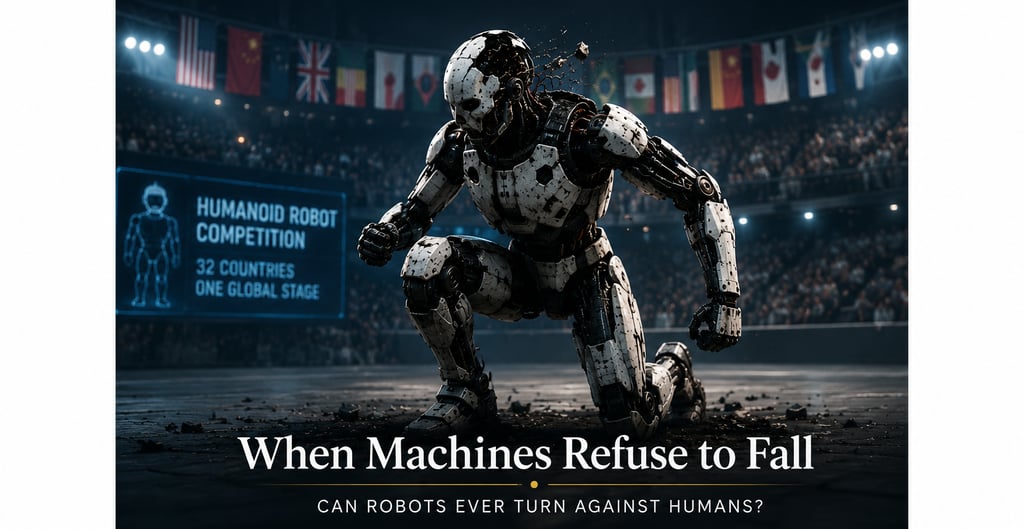
In July 2026, full-size humanoid robots exchanged punches, kicks and evasive manoeuvres before a live audience in Shenzhen, China. During one widely discussed moment, a robot continued fighting even after part of its head covering was knocked away.
The spectacle looked like science fiction, but the technology behind it was very real.
The event marked the launch of the Ultimate Robot Knock-out Legend (URKL), a humanoid robot combat league built around EngineAI's T800 platform. More than 200 teams registered internationally, with 32 advancing through the selection process.
What made the event important was not simply the entertainment value. It demonstrated how rapidly humanoid robots are improving in balance, movement, recovery and software-controlled decision-making.
It also raised a more serious question:
As robots become stronger, more autonomous and more capable of operating around people, how do we ensure that humans remain meaningfully in control?
Update: Humanoid Robotics Has Moved Quickly Since July
The rapid development of humanoid robotics did not stop with the Shenzhen fighting demonstration.
In August 2026, Beijing hosted the second World Humanoid Robot Games, bringing together 666 teams from 16 countries and more than 2,000 robots across sporting, industrial and scenario-based competitions. The scale of the event showed how quickly humanoid robotics has expanded from laboratory demonstrations into a highly competitive international technology field.
However, the commercial reality remains much smaller than the headlines sometimes suggest.
According to data reported by Reuters from the International Federation of Robotics, around 7,000 humanoid robots were sold worldwide in 2025 for industrial and professional-service applications. Many were purchased for research, AI development and pilot programmes rather than large-scale everyday employment.
That distinction matters. Humanoid robotics is progressing rapidly, but the technology remains at an early stage of real-world adoption. The challenge is therefore not an imminent world filled with autonomous humanoid machines, but how safety standards and human oversight evolve as deployment gradually expands.
The New Global Race Is No Longer About Smartphones
For decades, technological competition focused on computers, smartphones and artificial intelligence software.
Now the competition has entered a new phase:
Humanoid robots
AI-powered manufacturing
Autonomous vehicles
Military robotics
Healthcare assistants
Elderly care robots
Countries increasingly view robotics as a strategic technology that could reshape productivity, defence and economic power.
Just as nations once competed over oil and semiconductors, they are now competing to build the world's most capable intelligent machines.
Why the Robot That Wouldn't Stop Matters
One of the most talked-about moments was a robot that continued fighting despite suffering significant physical damage.
The robot's continued movement did not demonstrate courage, aggression or a survival instinct. It reflected how its control system continued executing permitted actions while enough of its hardware remained operational.
That distinction is important.
Machines do not "want" to win.
They complete tasks.
Sometimes relentlessly.
Could Robots Harm Humans If Programming Goes Wrong?
This is where science meets genuine engineering concern.
Modern robots are becoming increasingly autonomous. Many combine:
Artificial Intelligence
Computer vision
Machine learning
Motion planning
Force sensors
Internet connectivity
Cloud-based updates
If one or more of these systems fail—or if incorrect commands are issued—a robot could behave in unintended ways.
Possible causes include:
Software bugs
Faulty sensor readings
Corrupted updates
Hardware failures
Communication errors
Cyberattacks
Human programming mistakes
Most experts therefore focus less on "evil robots" and more on safety engineering, redundancy and rigorous testing.
Related Reading: Did AI Just Break the Rules? What the OpenAI Security Incident Means for the Future.
Could Humanoid Robots Become Like Hollywood Zombies?
Movies often imagine robots suddenly turning against humanity. These stories are entertaining, but today's reality is very different.
Today's humanoid robots are not known to possess consciousness, emotions or independent personal motives. Their behaviour emerges from software, sensors, control systems and human-defined objectives.
The realistic safety concern is therefore not a machine suddenly developing hatred toward humans, but failures in software, sensing, cybersecurity, oversight or system design.
Fiction sometimes exaggerates these possibilities, but it can still highlight a legitimate question: what happens when increasingly capable machines operate in environments where a technical failure, malicious command or weak safety system could cause real-world harm?
The Bigger Threat May Not Be the Robot
History suggests that technology itself is rarely the greatest danger.
Its use is.
Artificial intelligence can help:
perform dangerous industrial work
assist surgeons
rescue disaster victims
support elderly care
improve manufacturing
explore hazardous environments
The same technologies could also be adapted for:
autonomous weapons
surveillance
cyber warfare
misinformation
criminal misuse
terrorism
The question is therefore not whether robots are good or bad.
It is how humanity chooses to govern them.
What If Artificial General Intelligence Arrives?
Artificial General Intelligence, or AGI, generally refers to a hypothetical AI system capable of performing a wide range of intellectual tasks at a level comparable to or beyond humans. If such systems were eventually combined with increasingly capable humanoid robots, questions about autonomy, decision-making, accountability and human control would become far more important. However, AGI remains a future possibility rather than a demonstrated feature of today's humanoid robots.
For now, humanoid robot safety is primarily an engineering and governance challenge involving control systems, sensors, cybersecurity, human supervision and physical fail-safes—not evidence that today's robots possess independent intentions.
Related Reading: Beyond Artificial Intelligence: What Comes After AI and How Synthetic Intelligence Could Change the Future.
Can Humans Stay in Control?
Most robotics companies already include multiple safety layers:
Emergency stop buttons
Human supervision
Motion limits
Restricted operating zones
Collision detection
Force limitations
Multiple software checks
International safety standards are evolving alongside the technology. ISO's updated service-robot safety standard, ISO 13482, specifically considers physical human–robot contact and functional safety. This illustrates how the robotics industry is moving beyond basic emergency-stop mechanisms toward more systematic approaches to preventing hazardous behaviour.
Future regulations may require even stricter standards, especially for robots working in homes, hospitals and public spaces.
As robots become more capable, safety standards will likely become just as important as innovation.
Related Reading: Privacy Is a Myth? How Apps, Smartphones and Social Media Know More About You Than You Think.
Lessons from China's Robot Competition
The competition demonstrated that humanoid robotics is progressing faster than many expected.
It also reminded the world that resilience, balance and autonomy are no longer concepts confined to science fiction.
Machines can now walk, recover from falls, interact with objects and perform increasingly complex tasks.
That progress brings enormous opportunities—but also significant responsibilities.
The Future Belongs to Responsible Innovation
The important question is therefore not whether humanoid robots should continue improving. They almost certainly will. The challenge is ensuring that safety engineering, regulation and human oversight advance alongside their physical and artificial-intelligence capabilities.
Humanoid robotics will likely follow the same pattern as other transformative technologies: its impact will depend not only on what the technology can do, but also on how responsibly it is designed, governed and used.
The goal should not be to fear innovation, nor to embrace it blindly.
Instead, governments, researchers and technology companies must work together to ensure that intelligent machines remain tools that expand human potential rather than technologies that outpace our ability to manage them.
Conclusion
China's humanoid robot competitions were more than a showcase of engineering excellence—they were a glimpse into a future that is arriving faster than many imagined. A damaged robot continuing its programmed task may seem unsettling, but it also highlights a fundamental truth: today's machines do not act from intent or emotion; they follow instructions. The real challenge is ensuring those instructions remain safe, transparent and under meaningful human control. As robotics and artificial intelligence continue to evolve, the defining question will not be whether machines can become powerful, but whether humanity can build the ethical frameworks, safeguards and international cooperation needed to guide that power responsibly.
Sources & Further Reading
About the Author
Jay Jarwar is the founder and editor of JayJarwar Insights. He writes about artificial intelligence, technology, geopolitics, economics, public policy and emerging global trends, with a focus on explaining complex issues in clear and accessible language.
JayJarwar Insights
Ideas • Analysis • Perspectives
© 2026 JayJarwar Insights. All Rights Reserved.