
Beyond Artificial Intelligence: AGI, Human–AI Integration and What Comes Next
What could come after today’s AI? Explore AGI, brain–computer interfaces, human–AI collaboration, quantum computing and the debate over machine consciousness.
By Jay Jarwar
6/29/20265 min read

Introduction
Artificial intelligence is advancing rapidly, but today's AI may represent only one stage in a much longer technological journey.
Modern AI systems can generate text and images, recognise patterns, analyse large amounts of data and assist with increasingly complex tasks. Yet they remain fundamentally different from the broad, adaptable intelligence associated with humans.
The Stanford Institute for Human-Centered AI describes artificial intelligence broadly as computer systems capable of performing tasks associated with human-like intelligence, including learning, reasoning, understanding language and making decisions.
The more difficult question is what might come next.
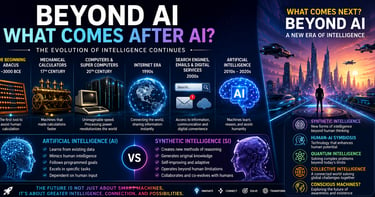
Researchers are exploring paths ranging from Artificial General Intelligence and brain–computer interfaces to human–AI collaboration, advanced robotics and quantum computing. Some writers and researchers also use terms such as synthetic intelligence to describe forms of machine intelligence that could differ significantly from today's systems.
None of these futures is guaranteed.
But together they raise a fascinating possibility: AI may not be the final destination in the evolution of machine intelligence.
Beyond Today's AI: The Idea of Synthetic Intelligence
The term synthetic intelligence does not yet have a single universally accepted scientific definition.
Different researchers use it in different contexts, including neuromorphic computing, unconventional computing and attempts to create intelligence using architectures that differ from mainstream artificial neural networks.
For this reason, it is better to think of synthetic intelligence not as a confirmed technological stage after AI, but as an umbrella idea for possible forms of engineered intelligence that may operate differently from today's AI systems.
Future systems might, for example:
Use radically different computing architectures
Learn with much greater energy efficiency
Interact more deeply with physical environments
Combine biological and digital forms of computation
Collaborate with humans in new ways
Whether such systems should eventually be called synthetic intelligence, advanced AI or something entirely different remains an open question.
Human–AI Integration: From Science Fiction to Early Reality
One possible future may involve not replacing human intelligence but connecting it more closely with machines.
Brain–computer interfaces are already demonstrating limited but important examples of direct interaction between neural activity and computers.
A Nature study on speech brain–computer interfaces demonstrated that neural signals from a person with paralysis could be decoded into text at substantial speed, illustrating the potential of neurotechnology to restore communication.
This is still very different from science-fiction ideas such as instantly downloading knowledge or dramatically expanding human memory.
However, continued advances in brain–computer interfaces could eventually allow closer interaction between biological and artificial information systems.
The more realistic near-term possibilities include:
Restoring communication for people with paralysis
Controlling digital devices through neural signals
Improving assistive technologies
Combining human judgement with computational support
The long-term possibilities remain far more uncertain.
Related Reading: The Future of Work: Will Humans and AI Become Partners or Competitors?
Human–AI Collective Intelligence
The future of intelligence may also involve networks of people and AI systems working together.
Rather than asking whether humans or machines will be more intelligent, researchers are increasingly studying human–AI collaboration.
The results are more complicated than simply assuming that two forms of intelligence are always better than one. A Nature Human Behaviour meta-analysis of more than 100 experiments found that human–AI combinations generally performed better than humans working alone, but did not consistently outperform whichever of the human or AI was already strongest.
The effectiveness of collaboration therefore depends on the task and on how responsibility is divided between humans and machines.
Future collective-intelligence systems could potentially combine:
Human judgement and creativity
AI processing and pattern recognition
Sensors and real-time data
Robotics
Large-scale digital networks
Such systems could assist scientific research, healthcare, engineering and other complex fields—but their effectiveness will depend on good system design rather than simply connecting more intelligence together.
Quantum Computing and AI
Quantum computing represents another possible technological frontier, but it should not be confused with a guaranteed new form of intelligence.
Traditional computers process information using bits, while quantum computers use quantum bits, or qubits, and exploit phenomena including superposition and interference.
According to IBM's overview of quantum computing, sufficiently advanced quantum computers could eventually offer major advantages for certain specialised problems, particularly in areas such as molecular simulation, chemistry, materials science and complex optimisation.
Researchers are also investigating ways in which quantum computing and artificial intelligence might complement one another.
However, quantum computers are not expected to replace classical computers for most tasks, and practical large-scale quantum computing remains under development.
The more reasonable possibility is that future AI systems could use a combination of classical computing, specialised accelerators and quantum resources for particular problems.
That could expand what machines are capable of solving without requiring us to assume the arrival of a completely separate form of “quantum intelligence.”
Artificial General Intelligence: A More Immediate Frontier?
Before speculating about entirely new forms of machine intelligence, there is another major concept attracting enormous attention: Artificial General Intelligence (AGI).
The Stanford Institute for Human-Centered AI describes AGI as an AI system with general, human-level or greater ability to learn, reason and apply knowledge across a wide range of tasks and domains.
Unlike specialised systems, an AGI would theoretically be able to adapt knowledge to unfamiliar situations rather than performing well only within narrow areas.
However, AGI itself remains difficult to define precisely. There is no universally accepted test for determining when a system has achieved human-level general intelligence.
This means predictions about when—or whether—AGI will arrive should be treated cautiously.
Related Reading: The Global AI Race: Who Will Reach Artificial General Intelligence First?
Could Machines Ever Become Conscious?
Perhaps the most difficult question is not whether machines can become more capable, but whether they could ever become conscious.
Intelligence and consciousness are not the same thing.
A system might perform sophisticated reasoning or communication without necessarily possessing subjective experience or self-awareness.
An interdisciplinary research report, Consciousness in Artificial Intelligence, examined current AI systems using indicators derived from several scientific theories of consciousness. The authors concluded that the systems they assessed did not qualify as conscious under those indicators, while also arguing that there were no obvious technical barriers to future systems satisfying some of them.
The scientific question therefore remains unresolved.
If future systems ever showed credible evidence of consciousness, society would confront extraordinarily difficult questions about:
Moral responsibility
Rights and legal status
Human control
Accountability
Machine autonomy
The meaning of personhood itself
For now, these questions remain speculative—but they are becoming increasingly worthy of serious scientific and ethical discussion.
Related Reading: Is Artificial Intelligence Killing Human Creativity?
Final Perspective: AI May Be the Beginning, Not the End
Artificial intelligence should not automatically be viewed as the final form of machine intelligence.
The decades ahead may bring more capable general-purpose AI, closer human–machine collaboration, advanced brain–computer interfaces, new computing architectures and specialised quantum technologies.
Some ideas may succeed. Others may remain science fiction.
The most important lesson is therefore not that one particular technology will certainly replace today's AI, but that the technological foundations of intelligence are still evolving.
Humanity has spent thousands of years developing tools that extend physical and intellectual capabilities. Artificial intelligence represents a remarkable new chapter in that process—but it may not be the last.
The future may ultimately be shaped not by humans competing against machines, but by how successfully we decide which capabilities should be automated, which should remain human, and where the combination of the two creates something genuinely better.
Sources & Further Reading
Stanford Institute for Human-Centered AI — What Is Artificial Intelligence?
Stanford Institute for Human-Centered AI — What Is Artificial General Intelligence?
Nature Human Behaviour — When Combinations of Humans and AI Are Useful
Consciousness in Artificial Intelligence — Insights from the Science of Consciousness
About the Author
Jay Jarwar is the founder and editor of JayJarwar Insights. He writes about artificial intelligence, technology, geopolitics, economics, public policy, and emerging global trends, with a focus on explaining complex issues in clear and accessible language.
JayJarwar Insights
Ideas • Analysis • Perspectives
© 2026 JayJarwar Insights. All Rights Reserved.