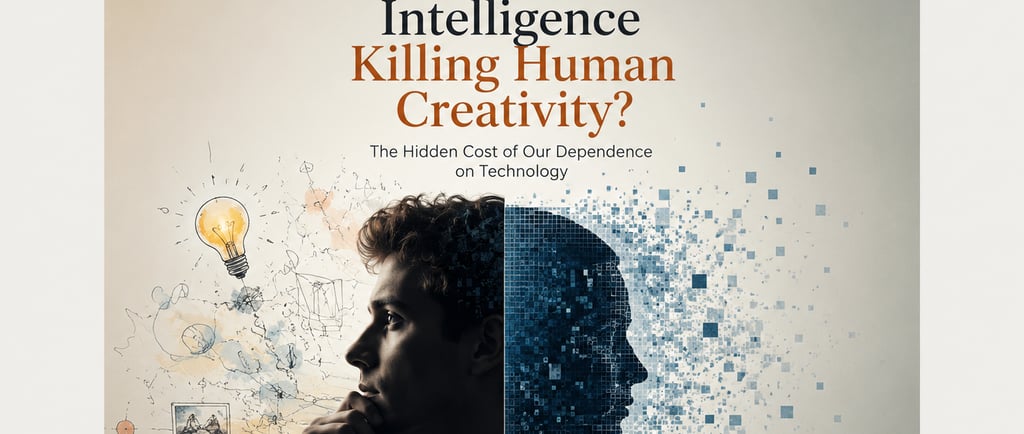
Is Artificial Intelligence Killing Human Creativity? The Hidden Cost of Our Dependence on Technology
As AI transforms education, work and creativity, are we becoming more innovative or simply more dependent? Explore the opportunities, risks and future of human creativity in the age of artificial intelligence.
By Jay Jarwar
7/21/20264 min read
Introduction
Artificial Intelligence is transforming the way we live, learn, work and create. From generating artwork and writing essays to composing music and designing products, AI has become one of the most powerful technologies of the 21st century. Tasks that once demanded years of practice can now be completed in seconds.
But amid this remarkable progress, a deeper question is emerging:
Are we becoming more creative—or simply more dependent on intelligent machines?
The answer is unlikely to be black or white. AI is opening extraordinary opportunities, yet it may also be quietly reshaping the very human abilities that have driven innovation for centuries.
Creativity Has Always Been a Human Strength
Human creativity is more than producing beautiful paintings or writing novels. It is our ability to imagine possibilities, solve unfamiliar problems, connect unrelated ideas and express emotions through original thinking.
Every major breakthrough—from scientific discoveries to works of art—began inside the human mind before becoming reality.
Technology has always supported creativity. The printing press, cameras, computers and the internet expanded human potential rather than replacing it.
The question today is whether AI remains a tool—or begins to become the thinker.
The Promise of Artificial Intelligence
There is no denying AI's enormous benefits.
Students can learn more efficiently.
Researchers can analyze vast amounts of information.
Doctors receive faster diagnostic assistance.
Businesses automate repetitive tasks.
Artists and designers can experiment with new ideas at unprecedented speed.
For many professionals, AI removes routine work, allowing more time for strategic and creative thinking.
In this sense, AI has the potential to enhance—not diminish—human creativity.
Where Dependence Becomes a Concern
The concern arises when convenience gradually replaces effort.
If every article is written by AI.
Every design is generated automatically.
Every problem is solved by a chatbot.
People may gradually practice critical thinking, imagination, and originality less frequently.
Like any skill, creativity strengthens through use and weakens through neglect.
The greatest risk may not be AI itself, but our willingness to stop thinking independently.
Related Reading: What happens when these same questions reach the workplace? Explore The Future of Work: Will Humans and AI Become Partners or Competitors?
A 2025 study of 319 knowledge workers found that greater confidence in generative AI was associated with less critical thinking, while AI use shifted cognitive effort toward checking, integrating, and supervising machine-generated outputs.
Are We Outsourcing Our Thinking?
History suggests that humans often become dependent on technologies that make life easier.
Generative AI introduces a new form of cognitive offloading: instead of merely helping people retrieve information, it can draft, summarise, analyse, and propose answers on their behalf. This can save time, but it also makes active verification increasingly important. Research on knowledge workers suggests that routine or lower-stakes AI-assisted tasks may involve less perceived critical-thinking effort, particularly when users place high confidence in the technology.
AI could similarly reshape how we generate ideas.
If people begin accepting AI's first answer without questioning, refining or challenging it, creative thinking may slowly become passive rather than active.
Education Faces a New Challenge
Schools and universities are already adapting.
Students can now generate essays, solve coding assignments, and answer complex questions almost instantly.
While AI can personalize education and improve learning, excessive reliance could reduce opportunities to develop analytical reasoning, writing skills, and independent research.
The OECD's Digital Education Outlook 2026 reaches a similar conclusion: generative AI can improve task performance and support learning when used with a clear educational purpose, but simply outsourcing cognitive tasks to general-purpose AI does not necessarily produce genuine learning gains. UNESCO likewise advocates a human-centred approach in which AI supports, rather than displaces, human agency in education and research.
The challenge for educators is no longer preventing AI use, but teaching students how to use it responsibly.
Creativity Is More Than Content Generation
Producing words or images is only one part of creativity.
True creativity involves:
Curiosity
Observation
Emotional intelligence
Life experience
Failure and experimentation
Ethical judgment
AI can imitate patterns from existing knowledge, but it does not experience joy, loss, hope, fear or inspiration in the human sense.
These experiences continue to shape authentic human creativity.
Could AI Actually Make Us More Creative?
There is another perspective worth considering.
Some experts argue that AI may become one of history's greatest creative partners.
Instead of replacing imagination, AI could accelerate it.
A 2024 experiment published in Science Advances found that access to generative-AI ideas improved the creativity and quality of individual short stories, particularly for participants who initially scored lower on creativity. However, AI-assisted stories also became more similar to one another, suggesting a possible trade-off between individual creative performance and collective diversity.
Writers overcome writer's block.
Scientists explore new hypotheses.
Architects visualize ideas faster.
Entrepreneurs test business concepts within minutes.
Musicians experiment with entirely new styles.
Used wisely, AI becomes a collaborator rather than a competitor.
Related Reading: Beyond Artificial Intelligence - What comes After AI and How Synthetic Intelligence could Change the Future
The Real Question Is Balance
Perhaps the debate is not whether AI is killing creativity.
A better question is:
How can humanity preserve creativity while embracing intelligent technology?
The answer may lie in maintaining a balance where humans remain the decision-makers, and AI remains the assistant.
Technology should expand our thinking—not replace it.
What the Future May Look Like
The future workforce may reward people who combine uniquely human abilities with AI tools.
Skills likely to become even more valuable include:
Critical thinking
Emotional intelligence
Ethical reasoning
Original storytelling
Leadership
Complex problem-solving
The OECD's 2026 Skills in the AI Age report similarly identifies critical thinking, creativity, collaboration, and problem-solving as increasingly important complementary skills because they help people work effectively with AI and adapt as tasks change.
Final Perspective: Creativity Still Requires Human Agency
Artificial Intelligence is neither the villain nor the saviour of human creativity.
Like every revolutionary technology, its impact depends on how we choose to use it.
Related Reading: As AI capabilities advance, the debate over human creativity is part of a much larger question about the future of intelligence. Read The Global AI Race: Who Will Reach Artificial General Intelligence First?
If AI becomes a substitute for thinking, society risks losing some of the qualities that define humanity.
If it becomes a partner that frees people from repetitive work and encourages deeper exploration, it could help unlock a new era of innovation.
The future of creativity will not be decided by artificial intelligence alone.
It will be shaped by whether humans continue to ask questions, challenge ideas, imagine possibilities and create with purpose.
About the Author
Jay Jarwar is the founder and editor of JayJarwar Insights. He writes about artificial intelligence, technology, geopolitics, economics, public policy and emerging global trends, with a focus on explaining complex issues in clear and accessible language.
JayJarwar Insights
Ideas • Analysis • Perspectives
© 2026 JayJarwar Insights. All Rights Reserved.