
Trump’s Iran Gamble: War, Oil and Global Consequences
Trump's renewed military campaign against Iran threatens global oil supplies, regional stability and US politics. Explore the risks, strategy and consequences.
JayJarwar Insights
7/20/20264 min read
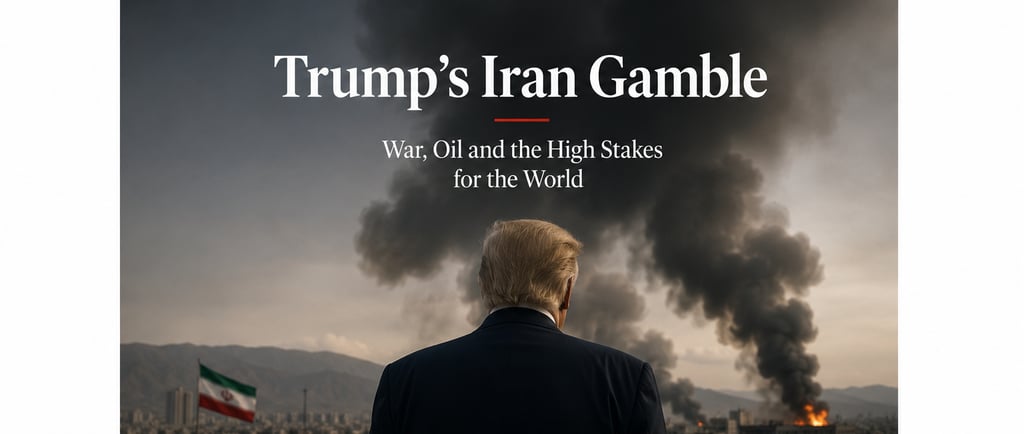
Trump’s Iran Gamble: How the Collapse of the Ceasefire Could Reshape the Middle East, Global Energy Markets and US Politics
Just weeks after celebrating a ceasefire with Iran as a breakthrough capable of preventing a global economic crisis, US President Donald Trump has reversed course and resumed military operations against Iranian targets. The renewed escalation has reignited one of the world's most dangerous geopolitical flashpoints and raised difficult questions about American strategy, global energy security and the political costs of another prolonged conflict.
As both Washington and Tehran accuse each other of violating the Memorandum of Understanding (MoU), diplomacy appears to be giving way to military confrontation. The consequences extend far beyond the Middle East. Oil markets, international shipping, regional alliances and the future of US foreign policy could all be reshaped by decisions made in the coming weeks.
From Ceasefire to Renewed Conflict
The June MoU was intended to create a temporary pause in hostilities while negotiations continued over Iran's nuclear programme, sanctions relief and maritime security in the Strait of Hormuz.
Under the arrangement:
Iran was expected to facilitate commercial shipping through the Strait.
The United States would ease selected sanctions.
Both sides would use the ceasefire to negotiate a broader political settlement.
Instead, both governments now claim the other violated the agreement.
Related Reading: The latest escalation did not emerge in isolation. It builds upon months of rising tensions that have already disrupted global energy markets, threatened international shipping and increased geopolitical uncertainty. For the broader background, read: U.S.-Iran Hostilities Resume: How Renewed Conflict Could Impact Global Peace, Oil Prices and the World Economy.
Washington argues that Iranian attacks on commercial shipping and regional partners breached the spirit of the deal.
Tehran maintains that renewed US military strikes and naval pressure effectively destroyed the agreement before implementation could begin.
The result is a rapid return to military escalation.
The Strait of Hormuz Remains the Centre of the Crisis
Although discussions often focus on Iran's nuclear programme, the real strategic contest increasingly revolves around the Strait of Hormuz.
Approximately one-fifth of globally traded oil normally passes through this narrow waterway.
For Iran, control over Hormuz represents its strongest strategic bargaining tool.
For the United States and Gulf allies, uninterrupted navigation is essential to global economic stability.
Disagreement over shipping routes, maritime control and freedom of navigation appears to have become one of the central reasons behind the collapse of negotiations.
This makes the conflict far more than a bilateral dispute—it directly affects global energy markets.
Trump's Strategic Calculation
Supporters argue that renewed military pressure is intended to:
Restore deterrence.
Force Iran back into negotiations from a weaker position.
Reduce Tehran's influence over regional shipping.
Prevent further expansion of Iran's military capabilities.
However, critics question whether military escalation can realistically achieve these objectives without creating even greater instability.
Several analysts argue that Iran has historically demonstrated a willingness to absorb significant economic and military pressure rather than accept externally imposed political conditions.
If that assessment proves correct, additional strikes may strengthen Iranian resistance rather than weaken it.
Iran's Response
Iran has responded by:
Launching drones and missiles toward US partners in the Gulf.
Expanding attacks against strategic infrastructure.
Suspending implementation of the MoU.
Accusing Washington of violating international commitments.
Iranian leaders have also warned that continued attacks could result in broader retaliation throughout the Gulf region.
Related Reading: The renewed US-Iran confrontation also highlights how modern conflicts are increasingly being shaped by low-cost drones, precision strikes and autonomous technologies rather than conventional armies. Understanding this transformation is essential to appreciating today's battlefield. Read our analysis: Drone Warfare in the 21st Century: How Cheap Flying Machines are Revolutionizing Modern Warfare.
Such actions increase the possibility that neighbouring countries—including Kuwait, Bahrain, Jordan, Qatar and the United Arab Emirates—may become increasingly involved, whether intentionally or inadvertently.
Rising Humanitarian Concerns
Reports indicate damage to civilian infrastructure, including water facilities, power systems and transportation networks.
If independently verified, attacks on civilian infrastructure by any party would raise serious concerns under international humanitarian law.
Beyond immediate casualties, destruction of desalination plants and water systems can have long-term humanitarian consequences for civilian populations already living under difficult conditions.
Protecting non-combatants remains a legal and moral obligation for all parties engaged in armed conflict.
Economic Consequences Beyond the Battlefield
The conflict extends far beyond military calculations.
Any prolonged disruption to Hormuz could produce:
Higher oil prices.
Increased transportation costs.
Rising inflation worldwide.
Greater uncertainty in financial markets.
Supply chain disruptions.
Although global energy markets have become more diversified over the past decade, Hormuz remains too important to replace quickly.
Energy-importing nations across Asia and Europe would likely experience the greatest economic pressure if the conflict continues.
Political Risks for the Trump Administration
Military escalation also carries domestic political consequences.
With US midterm elections approaching, prolonged conflict could influence voter perceptions regarding:
Inflation.
Fuel prices.
National security.
Government spending.
Foreign policy priorities.
Some conservative commentators who traditionally favour a more restrained foreign policy have questioned whether renewed military operations align with the "America First" approach that helped define Trump's political movement.
If military operations become lengthy or require deeper US involvement, political divisions inside Washington may widen further.
Could This Become Another Long War?
Perhaps the greatest concern is the possibility of gradual escalation.
Military conflicts rarely expand overnight.
Instead, they often evolve through repeated cycles of retaliation.
Each strike creates pressure for another response.
Each response increases political costs for backing down.
Without active diplomacy, even limited military campaigns can gradually develop into prolonged regional wars.
While a large-scale ground invasion appears unlikely at present, continued escalation significantly increases uncertainty.
Diplomacy Still Offers the Best Exit
History demonstrates that military pressure alone rarely produces lasting political settlements.
Even if battlefield objectives are achieved, sustainable peace usually requires:
Direct negotiations.
Regional diplomatic engagement.
Confidence-building measures.
International monitoring.
Practical agreements addressing both security and economic concerns.
Neither Washington nor Tehran appears willing to abandon its core strategic interests.
That reality makes diplomacy difficult—but ultimately indispensable.
Conclusion
The collapse of the US-Iran ceasefire illustrates how fragile temporary agreements can become when underlying disputes remain unresolved.
The struggle is no longer limited to nuclear negotiations. It now encompasses maritime security, regional influence, global energy markets and great-power credibility.
President Trump's renewed military strategy may increase pressure on Iran, but it also raises the risks of wider regional conflict, economic instability and domestic political consequences inside the United States.
Likewise, Iran's retaliatory actions may strengthen its negotiating leverage in the short term while simultaneously increasing international isolation and humanitarian suffering.
Ultimately, neither military escalation nor economic coercion alone is likely to deliver lasting stability. Whether this confrontation evolves into another prolonged regional conflict—or returns to diplomacy—will depend on decisions taken not only in Washington and Tehran, but also by regional partners and the wider international community.
In an interconnected world where a single maritime corridor influences global energy supplies, the outcome of this confrontation will be felt far beyond the Middle East.
JayJarwar Insights
Ideas • Analysis • Perspectives
© 2026 JayJarwar Insights. All Rights Reserved.