
When Missiles Meet Markets: How the U.S.–Iran War Is Reshaping the Global Economy
The U.S.–Iran war is disrupting oil, shipping, fertilizer markets and global trade. Explore how a prolonged conflict could affect inflation, food security and economic growth.
By Jay Jarwar
7/27/20266 min read
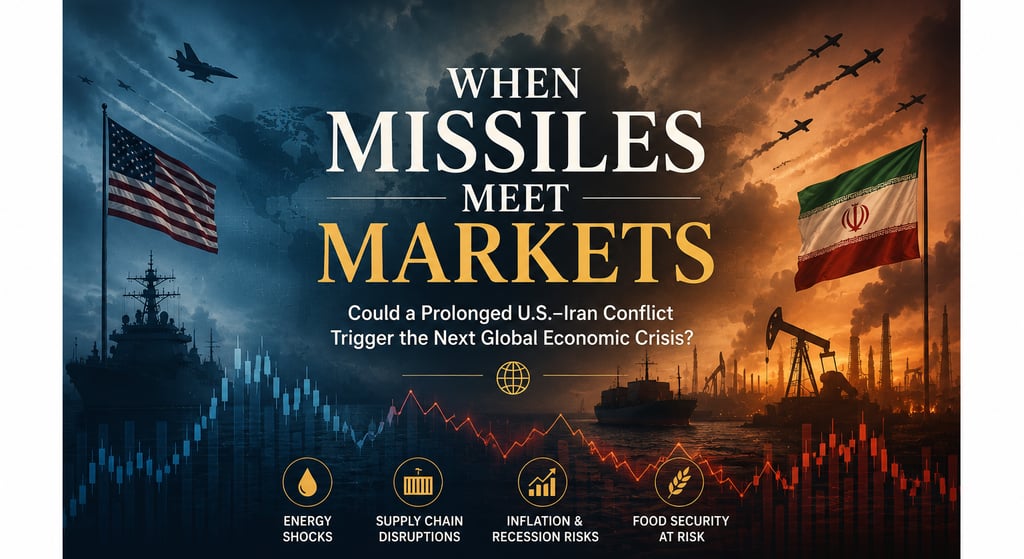
The War May Be Regional—Its Consequences Won't Be
Wars rarely remain confined to the territories where they begin. They may start with strategic decisions in government offices and military command centres, but their consequences ripple across continents, affecting economies, businesses, food supplies, and the daily lives of millions who have no role in the conflict.
The renewed confrontation between the United States and Iran is another reminder that modern warfare extends far beyond missiles and military operations. Every escalation carries the potential to reshape financial markets, disrupt global trade, and deepen humanitarian suffering.
Related Reading: Trump's Iran Gamble: War, Oil and Global Consequences
By late August 2026, the confrontation had already evolved into a prolonged economic and strategic crisis. Nearly six months of conflict have disrupted energy flows through the Strait of Hormuz, raised shipping and fuel costs and created new inflationary pressures far beyond the Middle East. The question is therefore no longer simply whether the war could affect the global economy, but how deep and lasting those effects may become.
Beyond the Headlines: The Human Cost of Endless Retaliation
Every missile launched and every drone strike reported in the news represents more than a military statistic.
Behind each headline are families searching through rubble, children growing up amid uncertainty, workers losing their livelihoods, and communities watching decades of infrastructure disappear within moments.
Roads, bridges, ports, hospitals, power stations, communication networks, and industrial facilities can all become casualties of conflict. While governments calculate strategic gains and losses, ordinary people pay the highest price.
History repeatedly reminds us that wars create far more victims than victors.
Related Reading: Drone Warfare in the 21st Century: How Cheap Flying Machines Are Revolutionizing Modern Warfare
When Bombs Shake the Markets Before They Shake the Ground
Financial markets often react long before shortages become visible.
The prolonged confrontation between the United States and Iran has increased uncertainty across global markets. Geopolitical tensions can make investors more cautious, while shipping companies may face higher insurance premiums and transportation costs. Greater energy-price volatility can then raise production costs across multiple industries. As businesses pass these higher costs on to consumers, inflationary pressures can intensify, reducing purchasing power and slowing economic activity.
Those pressures have already appeared in 2026. The U.S. Energy Information Administration reports that crude oil and petroleum-liquid flows through the Strait of Hormuz averaged only about 4.9 million barrels per day in the second quarter of 2026, compared with 21.6 million barrels per day in the final quarter of 2025. Brent crude also traded above US$100 per barrel during parts of the crisis.
Confidence—one of the world's most valuable economic assets—can disappear much faster than it is rebuilt.
Further Reading: Could the U.S.–Iran War Disrupt Artificial Intelligence? How Gulf Data Centres Have Become the New Digital Battlefield
From Oil Tankers to Store Shelves: How Supply Chains Could Break
The global economy operates through an intricate network of shipping routes, manufacturing hubs, financial institutions, and logistics systems.
When conflict threatens major trade corridors or raises transportation costs, delays spread throughout international supply chains.
Related Reading: The New Great Game: CPEC, BRICS, Sea Power and pakistan's place in an Emerging Multipolar World
Factories may struggle to receive raw materials.
Retailers may experience shortages.
Manufacturers may reduce production.
Consumers may eventually pay higher prices for everyday essentials.
UN Trade and Development reports that disruptions through the Strait of Hormuz have increased energy, transport, logistics and production costs across the global economy. Although the value of global trade continued to rise in the first half of 2026, a significant share of that increase reflected higher prices rather than stronger underlying trade volumes.
Thus, what begins as a geopolitical crisis can gradually evolve into an economic challenge felt in households thousands of kilometres away.
The Silent Victim of War: Agriculture and Global Food Security
Among the most overlooked consequences of prolonged conflict is its impact on agriculture.
Modern farming relies heavily on uninterrupted supplies of fuel, fertilizers, machinery, transportation, and international trade.
If fertilizer production or transportation is disrupted, farmers may be forced to reduce fertilizer use or delay planting seasons. Lower agricultural productivity could eventually reduce crop yields, tighten food supplies, and place upward pressure on food prices.
The Food and Agriculture Organization has warned that the 2026 disruption of shipping through Hormuz is affecting both fertilizer availability and agricultural input costs. Because the Strait is important for energy and fertilizer trade, prolonged disruption could reduce fertilizer use, weaken future crop yields and increase food-security risks—particularly in import-dependent developing economies.
The World Bank reported that global fertilizer prices during the first five months of 2026 were around 35% higher than during the corresponding period a year earlier.
For developing countries already struggling with inflation and climate-related challenges, even modest disruptions can significantly worsen food insecurity.
Further Reading: Europe's Deadly Heatwave: How Climate Change Is Reshaping Europe and the United Kingdom
The battlefield may be thousands of kilometres away, yet its effects could eventually reach farms, grocery stores, and family dining tables around the world.
Could the World Be Drifting Toward Another Economic Slowdown?
A single conflict does not automatically trigger a global recession.
However, the economic slowdown is no longer merely theoretical. The World Bank's June 2026 Global Economic Prospects report projected global growth to weaken as the Middle East conflict disrupted energy markets and trade. Under a more severe scenario involving prolonged energy disruption and financial stress, the Bank estimated that global growth could fall to around 1.3% in 2026 while global inflation could rise to approximately 4.4%.
However, history suggests that prolonged geopolitical instability—combined with persistent inflation, elevated energy prices, disrupted supply chains, weakening consumer confidence, and reduced investment—can significantly slow economic growth.
Businesses delay expansion.
Consumers reduce spending.
Governments divert public resources toward defence and emergency measures instead of infrastructure, education, healthcare, or innovation.
When these pressures accumulate, economic momentum begins to weaken.
Related Reading: Economic Growth Without Prosperity? Rethinking Development in Pakistan's Poverty Debate
Why Developing Economies May Carry the Heaviest Burden
The consequences of an energy shock are highly uneven. Wealthier economies generally have greater fiscal capacity, strategic reserves and access to international finance. Many lower-income countries do not.
UN Trade and Development has identified 61 vulnerable economies exposed simultaneously to oil and cereal-import shocks from the Hormuz disruption. High debt-service burdens leave many of these governments with limited room to subsidise fuel, protect households or support businesses.
This means the greatest economic damage from a Middle Eastern conflict may ultimately be felt in countries geographically far removed from the battlefield.
The Real Cost of War Cannot Be Measured in Missiles
Military victories are often measured in territory gained or strategic objectives achieved.
The true cost of war is measured differently.
It is measured in children who lose access to education.
It is measured in families displaced from their homes.
It is measured in rising food prices, interrupted livelihoods, damaged economies, and opportunities that disappear before they can be realised.
Long after the final missile is launched, societies continue paying the price through rebuilding, recovery, and lost generations.
Related Reading: Beyond the Strait of Hormuz: Why Gulf Nations Are Quietly Redrawing the Global Energy Map
History Will Remember the Choices Made Today
The events of 2026 have already demonstrated that modern wars do not remain confined to battlefields. Missiles launched in the Gulf can influence petrol prices in America, fertilizer costs in Asia, food affordability in Africa and shipping expenses across the global economy.
Yet a global economic crisis is not inevitable. Energy producers have redirected some supplies, markets have adjusted, inventories have provided temporary buffers and diplomatic efforts continue.
The real danger arises if several pressures persist simultaneously: restricted energy flows, elevated fuel prices, expensive fertilizers, disrupted shipping, renewed inflation and weakening investment.
Further Reading: From Bullets to Balance Sheets: How Economic Power Is Redefining Global Competition in the 21st Century.
When missiles meet markets, economic resilience can become almost as important as military strength. The longer a conflict continues, the greater the risk that its most enduring consequences will be measured not only on the battlefield, but in household budgets, lost investment and slower global development.
Sources & Further Reading
About the Author
Jay Jarwar is the founder and editor of JayJarwar Insights. He writes about artificial intelligence, technology, geopolitics, economics, public policy and emerging global trends, with a focus on explaining complex issues in clear and accessible language.
JayJarwar Insights
Ideas • Analysis • Perspectives
© 2026 JayJarwar Insights. All Rights Reserved.