
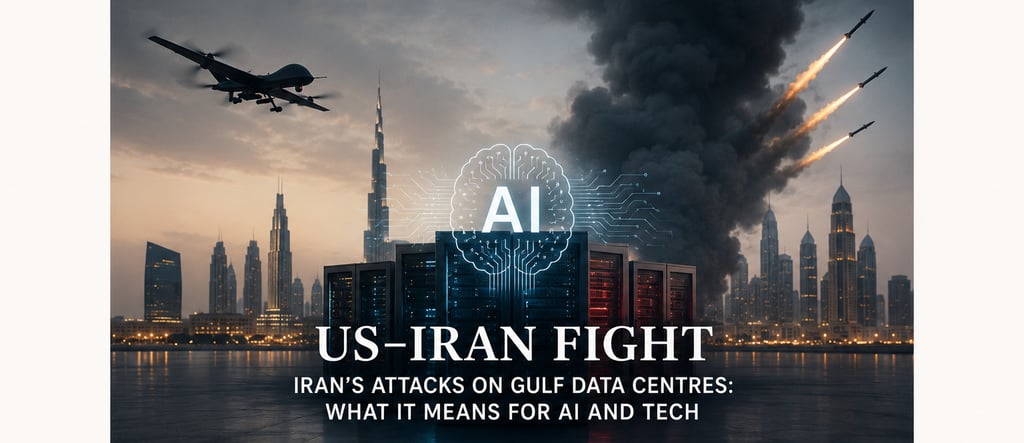
Could the US-Iran War Disrupt Artificial Intelligence? How Gulf Data Centres Have Become the New Digital Battlefield
As US-Iran tensions escalate, Gulf data centres face growing risks. Discover how attacks on digital infrastructure could affect AI, cloud computing, global businesses, and the future of technology.
JayJarwar Insights
7/21/20263 min read
Introduction
Modern wars are no longer fought only with missiles, fighter jets and warships. Increasingly, they are fought through electricity grids, internet cables, satellites, cloud servers and data centres.
As the confrontation between the United States and Iran intensifies, reports of attacks targeting critical infrastructure in Gulf states have raised a new question:
Could the next major casualty of war be Artificial Intelligence itself?
If military operations begin affecting data centres across the Gulf, the consequences could extend far beyond the Middle East, potentially disrupting AI services, cloud computing, financial markets and global digital businesses.
Why Gulf Data Centres Matter
Over the last decade, Gulf countries have invested billions of dollars to become regional technology hubs.
Major cloud providers have expanded rapidly across:
United Arab Emirates
Saudi Arabia
Qatar
Bahrain
Kuwait
These facilities host:
Artificial Intelligence workloads
Government cloud services
Banking systems
Healthcare databases
E-commerce platforms
Energy company operations
Military communications
Rather than being merely warehouses of computers, these data centres have become critical national infrastructure.
AI Runs on Data Centres
Artificial Intelligence depends upon enormous computing power.
Every AI system requires:
High-performance GPUs
Massive storage capacity
Continuous electricity
Reliable internet connectivity
Cooling systems
Cloud infrastructure
Without data centres, modern AI cannot function effectively.
Related Reading: While today's conflict demonstrates how Artificial Intelligence is transforming warfare and digital infrastructure, many experts believe AI is only the beginning of a much larger technological revolution. Explore what may come next in our analysis: Beyond Artificial Intelligence: What Comes After AI and How Synthetic Intelligence Could change the Future
Even temporary outages can interrupt:
AI assistants
Financial algorithms
Medical AI
Logistics platforms
Autonomous systems
Enterprise software
Why Data Centres Could Become Strategic Targets
Unlike conventional military bases, data centres represent economic power.
Related Reading: The growing use of drones against strategic targets highlights how modern warfare is rapidly evolving beyond conventional weapons. Affordable unmanned systems are reshaping military strategy, surveillance and precision strikes across the globe. Explore our in-depth analysis: Drone Warfare in the 21st Century: How Cheap Flying Machines are Revolutionizing Modern Warfare.
Disrupting them may:
Slow military communications
Interrupt financial transactions
Reduce cloud availability
Create public panic
Damage investor confidence
Although international humanitarian law seeks to protect civilian infrastructure, the distinction between civilian and military digital infrastructure has become increasingly blurred.
The Ripple Effect Across the Global Economy
If major Gulf data centres experience prolonged disruption, the impact may include:
AI Development
Training advanced AI models could slow if cloud resources become unavailable.
Financial Markets
Banks increasingly depend upon cloud computing for trading, payments and cybersecurity.
Energy Industry
Oil and gas production relies heavily on digital monitoring and industrial AI.
E-Commerce
Retail platforms require uninterrupted cloud services.
Aviation
Modern airports, airlines and logistics networks operate through interconnected digital infrastructure.
Related Reading: The current conflict did not emerge overnight. The collapse of the US-Iran ceasefire and the breakdown of diplomatic efforts laid the foundation for today's escalating military confrontation, growing regional instability and renewed risks to global energy markets. For a deeper geopolitical analysis, read: Trump's Iran Gamble: War, Oil and Global Consequences.
The Cyber Warfare Dimension
The greatest threat may not be physical destruction.
Cyberattacks can:
Encrypt data
Disable servers
Corrupt AI models
Interrupt communications
Steal sensitive information
Target cloud management systems
Future conflicts are likely to combine missiles with sophisticated cyber operations.
Why AI Companies Are Watching Closely
Technology giants such as Microsoft, Google, Amazon and Oracle have invested heavily in regional cloud infrastructure.
Any prolonged instability could encourage companies to:
Diversify data centre locations
Increase backup capacity
Expand cybersecurity investment
Accelerate distributed AI infrastructure
The lesson is becoming clear: resilience is now as important as innovation.
Could AI Become a Weapon?
The conflict also highlights another reality.
Artificial Intelligence is no longer merely supporting warfare—it is increasingly shaping it.
AI already assists in:
Drone navigation
Satellite imagery analysis
Missile defence
Target recognition
Intelligence gathering
Battlefield logistics
This means future wars may increasingly involve competition over computing infrastructure itself.
What It Means for Ordinary People
Most people never think about data centres.
Yet if they are disrupted, everyday life may be affected through:
Slower online services
Banking interruptions
Cloud outages
Delayed deliveries
Higher energy prices
Increased cybersecurity risks
Digital infrastructure has become as essential as roads, ports and power stations.
Related Reading: As AI becomes more deeply embedded in education, work and daily decision-making, concerns are growing about overdependence, originality and independent thought. For a broader reflection on this debate, read: Is Artificial Intelligence Killing Human Creativity? The Hidden Cost of Our Dependence on Technology.
The Bigger Picture
The US-Iran confrontation demonstrates that geopolitical competition is evolving beyond traditional battlefields.
Related Reading: The renewed US-Iran confrontation has consequences far beyond the battlefield, threatening global peace, energy security, international shipping and household living costs. For the wider economic and geopolitical context, read: U.S-Iran Hostilities Resume: How Renewed Conflict Could Impact Global Peace, Oil Prices and the World Economy.
The struggle now includes:
Energy corridors
Undersea internet cables
Satellites
Cloud computing
Artificial Intelligence
Critical digital infrastructure
Future conflicts may be decided not only by military strength but also by which nations can protect their digital ecosystems.
Conclusion
Whether or not Gulf data centres become direct targets, the conflict highlights a profound transformation in modern warfare. Artificial Intelligence depends on resilient digital infrastructure, and that infrastructure is increasingly intertwined with geopolitics.
The future battlefield will not be defined solely by tanks and missiles—it will also be shaped by servers, semiconductors, cloud platforms and AI systems. Nations that can safeguard these assets will hold a decisive strategic advantage in the digital age.
JayJarwar Insights
Ideas • Analysis • Perspectives
© 2026 JayJarwar Insights. All Rights Reserved.